
Cybersecurity Skills Resume: What to List (2026)
The cybersecurity job market is not short on openings. The Bureau of Labor Statistics projects information security analyst roles growing 33% through 2033 — roughly 17,000 new openings per year, far faster than the average across all occupations. But an abundance of job postings does not mean getting hired is easy. Security teams are small, budgets are scrutinized, and every hiring manager in the cybersecurity field has seen the resume that lists 40 tools and zero evidence of using any of them.
Your cybersecurity resume has to do two things simultaneously: pass the applicant tracking system with the right keywords, and convince a security professional that you can actually do the work. A well-crafted resume bridges that gap. A weak one — no matter how many certifications it lists — ends up in the rejection pile.
This guide covers exactly which cybersecurity skills to put on your resume, how to structure your skills section for ATS compatibility, how to write experience bullets that demonstrate real security work, and what separates a standout cybersecurity resume from the hundreds that all look the same.
What Counts as a Cybersecurity Skill on a Resume?
Cybersecurity skills fall into three categories, and a strong cyber security resume includes all three: technical skills, soft skills, and certifications or security clearances.
Technical skills are what applicant tracking systems scan for first. These include network security, security operations, cloud security, penetration testing, vulnerability assessment, security information and event management (SIEM), endpoint security, intrusion detection systems, encryption, firewall configuration, malware analysis, digital forensics, incident response, and security tools like Splunk, Metasploit, Wireshark, Nessus, and Burp Suite. Programming languages relevant to cybersecurity — Python, JavaScript, Bash, PowerShell — also belong here.
Soft skills matter more in cybersecurity than in most technical fields because security professionals constantly communicate risk to non-technical stakeholders. The soft skills recruiters scan for include communication, leadership, problem solving, analytical thinking, attention to detail, risk assessment, and the ability to explain complex security threats in plain language.
Certifications and security clearances carry significant weight. A Certified Information Systems Security Professional (CISSP) or CompTIA Security+ on your resume can be the difference between getting an interview and getting filtered out. Security clearances — if you hold one — should appear prominently.
The key is balance. A cybersecurity resume that lists only tools looks like a copy-paste from a job description. One that pairs each tool with a specific accomplishment looks like a professional who has done the work.
Top Cybersecurity Skills to List on Your Resume in 2026
Not every security skill carries equal weight on a resume. Here are the ones that appear most consistently in cybersecurity job descriptions and generate the strongest response from hiring managers.
Network Security and Security Operations
Network security remains the foundation of most cybersecurity roles. Whether you are applying for a security operations center (SOC) analyst position or a senior security engineer role, demonstrating that you understand how networks are attacked and defended is essential.
On your resume, go beyond listing "network security." Specify what you have actually secured: firewalls (Palo Alto, Fortinet, Cisco ASA), intrusion detection systems (Snort, Suricata), VPN configurations, network segmentation, DNS security, and traffic analysis. If you have worked in a security operations center, mention the volume of alerts you triaged and the tools you used.
Resume example: Monitored and triaged 200+ daily security alerts in a 24/7 SOC using Splunk and CrowdStrike, reducing mean time to detection from 45 minutes to under 8 minutes across a 12,000-endpoint environment.
Vulnerability Assessment and Penetration Testing
Vulnerability management is one of the highest-demand cybersecurity skills in 2026. Organizations want security professionals who can find weaknesses before attackers do — and who can communicate those findings to both technical teams and leadership.
List the specific tools you have used: Nessus, Qualys, Rapid7 InsightVM for vulnerability scanning; Metasploit, Burp Suite, Kali Linux for penetration testing. If you have conducted red team exercises, purple team assessments, or participated in bug bounty programs, those belong on your resume.
Resume example: Conducted quarterly penetration tests across 3 production web applications using Burp Suite and Metasploit, identifying 47 vulnerabilities including 6 critical findings that were remediated before the next compliance audit.
Cloud Security
As organizations continue migrating infrastructure to the cloud, cloud security has become a must-have cybersecurity skill. Recruiters scan for experience with AWS security services (IAM, GuardDuty, CloudTrail, Security Hub), Azure Security Center, Google Cloud security tools, and container security for Docker and Kubernetes environments.
Cloud security is especially important if you are targeting roles at technology companies, SaaS startups, or any organization with cloud-native infrastructure. Demonstrating that you can secure cloud environments — not just on-premise networks — signals that your skills are current.
Resume example: Designed and implemented AWS security architecture across 3 accounts using IAM least-privilege policies, CloudTrail logging, and GuardDuty threat detection — achieving SOC 2 Type II compliance with zero critical findings.
Security Information and Event Management (SIEM)
SIEM platforms are the central nervous system of most security operations teams. Experience with SIEM tools — Splunk, IBM QRadar, Microsoft Sentinel, Elastic Security, or LogRhythm — is one of the most frequently requested technical skills in cybersecurity job descriptions.
On your resume, do not just write "Splunk." Describe the scale of data you worked with, the custom detections or dashboards you built, and the outcomes those detections produced. Security analysts who can build effective detection rules are far more valuable than those who simply monitor alerts.
Resume example: Built 35+ custom Splunk correlation rules and dashboards for a financial services SOC, detecting 12 previously unidentified threat patterns and reducing false positive rates by 60% across endpoint and network data sources.
Incident Response and Forensic Analysis
When a security breach occurs, organizations need professionals who can contain the damage, investigate the root cause, and document findings for regulatory compliance and legal proceedings. Incident response and digital forensic science skills are critical for mid-level and senior cybersecurity roles.
On your resume, describe incidents you have responded to without revealing confidential details. Focus on methodology: containment time, tools used (EnCase, FTK, Volatility, YARA rules), evidence handling procedures, and the outcome of your investigation.
Resume example: Led incident response for a ransomware attack affecting 800+ endpoints, coordinating containment within 4 hours, conducting forensic analysis using EnCase and Volatility, and delivering root cause findings that prevented recurrence through policy and firewall changes.
Regulatory Compliance and Risk Management
Cybersecurity does not exist in a vacuum. Organizations operate under regulatory frameworks — NIST, ISO 27001, SOC 2, HIPAA, PCI DSS, GDPR — and security professionals who understand compliance carry additional value. Risk management and risk assessment skills demonstrate that you can translate technical vulnerabilities into business impact.
If you have experience with audit preparation, compliance gap analysis, security policy development, or risk assessment frameworks, include these on your resume. GRC (Governance, Risk, and Compliance) roles are growing rapidly.
Reality check: Technical screeners care about your tools and detection skills. But the hiring manager who signs off on the offer often cares more about whether you can explain risk in business terms. The best cybersecurity resumes demonstrate both.
Application Security and Secure Development
Application security skills are increasingly sought after as organizations shift security left into the development lifecycle. If you have experience with secure code review, OWASP Top 10, static and dynamic application security testing (SAST/DAST), web application firewalls, or DevSecOps practices, these belong on your resume.
For cybersecurity professionals who also write code, listing programming languages like Python, JavaScript, Go, or Rust alongside your security skills signals versatility that many employers value highly.
Resume example: Integrated SAST and DAST scanning into the CI/CD pipeline using Snyk and OWASP ZAP, reducing production security vulnerabilities by 72% over 6 months and enabling developers to fix issues before code review.
Reality check: Nobody gets hired because they know 25 acronyms. They get hired because they can reduce risk, communicate clearly, and prove it. Every tool and framework on your resume should point back to a specific outcome you produced.
How to Write Cybersecurity Resume Bullets
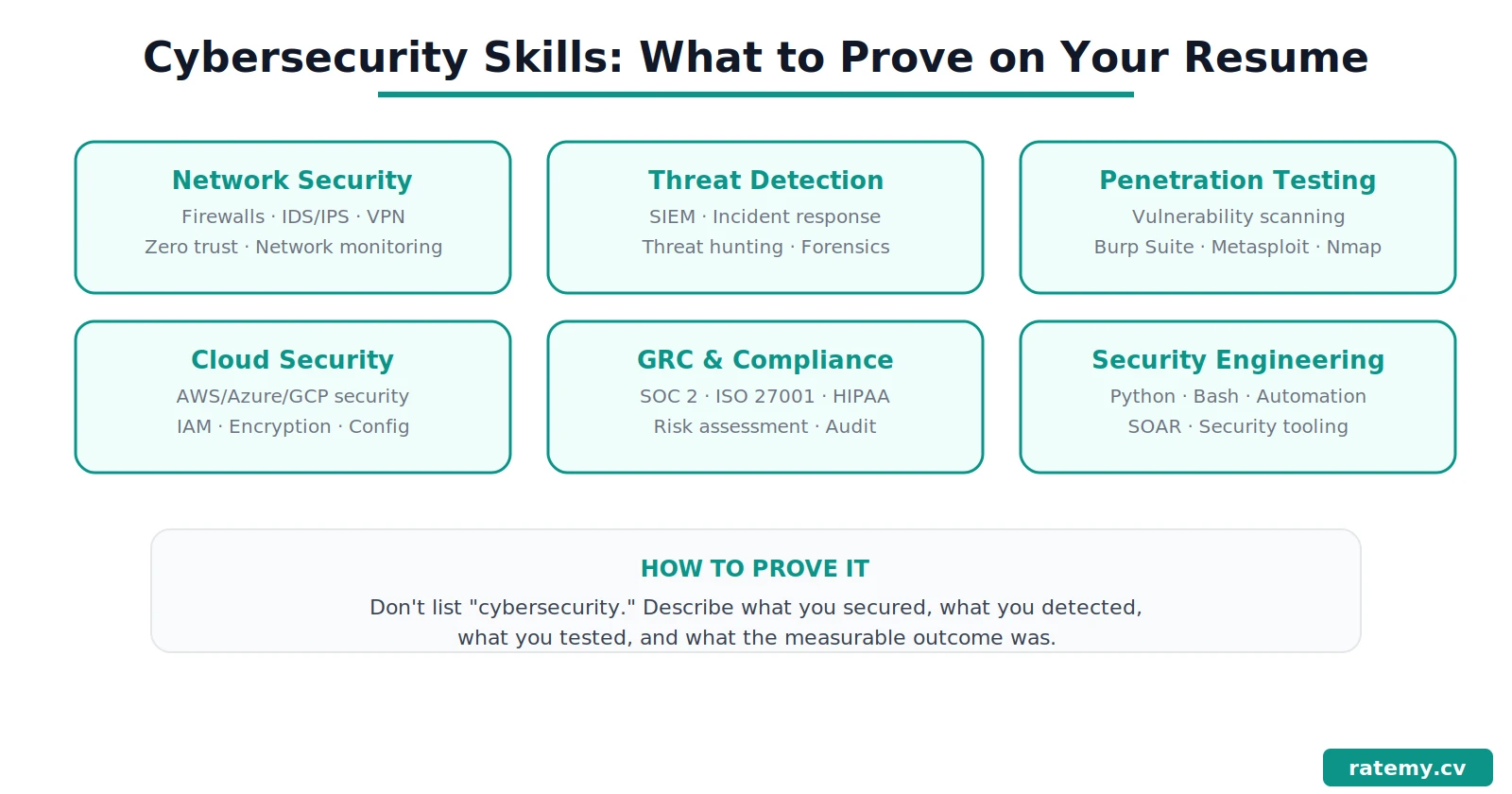
Security professionals often fall into the trap of writing resume bullets that describe responsibilities instead of demonstrating impact. Hiring managers in cybersecurity see hundreds of resumes that say "monitored security alerts" or "conducted vulnerability scans." Those bullets tell them nothing about your capability.
Use the Problem → Action → Result Framework
Every effective cybersecurity resume bullet follows this structure: what was the security challenge, what did you do about it, and what was the measurable outcome?
Weak: Responsible for monitoring network security and responding to incidents.
Strong: Detected and contained a credential-stuffing attack targeting 15,000 customer accounts by building a custom Splunk alert for anomalous login patterns, preventing an estimated $2.3M in potential fraud losses.
The weak version describes a job title. The strong version describes a cybersecurity professional who prevented real damage. That is the difference hiring managers notice.
Quantify Your Security Impact
Cybersecurity work produces measurable outcomes — you just have to frame them correctly. Metrics that work well on security resumes include: alerts triaged per day, mean time to detection, mean time to response, vulnerabilities identified, false positive reduction percentages, compliance audit results, endpoints protected, incidents contained, policy violations reduced, and cost of breaches prevented.
Entry-level cybersecurity analyst: Analyzed and triaged 150+ daily security alerts across Splunk and CrowdStrike, escalating 12 confirmed incidents per month and maintaining a 99.2% SLA compliance rate for initial response time.
Experienced security engineer: Automated security orchestration workflows using Python and SOAR platform, reducing average incident response time from 35 minutes to 6 minutes and freeing 20 analyst hours per week for proactive threat hunting.
Senior cybersecurity professional: Led security transformation initiative across a 5,000-employee organization, implementing zero-trust architecture that reduced successful phishing compromises by 94% and achieved SOC 2 Type II certification ahead of schedule.
Tailor Your Resume for Each Cybersecurity Role
A SOC analyst resume requires different emphasis than a penetration tester resume or a security engineer resume. Read each job description carefully and adjust your skills section and bullet ordering to match. If the posting emphasizes cloud security, lead with your AWS and Azure experience. If it emphasizes compliance, lead with your GRC and audit work.
You can check your resume against any cybersecurity job description for free to see exactly which security keywords you are missing.
Where to Put Cybersecurity Skills on Your Resume
Skills Section
Create a dedicated skills section grouped by category. This is what the ATS scans first:
Security Operations: SIEM (Splunk, QRadar), EDR (CrowdStrike, Carbon Black), IDS/IPS (Snort, Suricata), Firewall Management (Palo Alto, Fortinet)
Offensive Security: Penetration Testing, Metasploit, Burp Suite, Kali Linux, OWASP Top 10, Vulnerability Scanning (Nessus, Qualys)
Cloud Security: AWS (IAM, GuardDuty, CloudTrail), Azure Security Center, Container Security, Infrastructure as Code Security
Compliance & Risk: NIST CSF, ISO 27001, SOC 2, PCI DSS, HIPAA, Risk Assessment, Security Policy Development
Languages & Automation: Python, Bash, PowerShell, JavaScript, YARA, Sigma Rules
This structure lets both the applicant tracking system and the hiring manager quickly find what they need without scanning paragraph-style lists.
Resume Summary or Objective
Your professional summary should immediately communicate your experience level, security specialization, and impact. Keep it to 2-3 sentences.
Entry-level cybersecurity resume summary: CompTIA Security+ certified professional with hands-on experience in network security monitoring, vulnerability scanning, and incident triage through coursework and a 6-month SOC internship. Detected and documented 35+ security events during internship using Splunk and Wireshark.
Experienced cybersecurity resume summary: Cybersecurity analyst with 4+ years of experience in security operations, incident response, and vulnerability management for financial services environments. Proficient in Splunk, CrowdStrike, Nessus, and Python automation. Track record of reducing mean time to detection by 75% and achieving clean compliance audit results across SOC 2 and PCI DSS frameworks.
Certifications and Security Clearances
Certifications carry more weight in cybersecurity than in almost any other technology field. List them prominently — after your summary or in a dedicated section near the top. The most recognized certifications include:
Entry-level: CompTIA Security+, CompTIA Network+, Certified Ethical Hacker (CEH), Google Cybersecurity Professional Certificate
Mid-level: Certified Information Systems Security Professional (CISSP), Certified Information Security Manager (CISM), AWS Certified Security Specialty, GIAC Security Essentials (GSEC)
Specialized: Offensive Security Certified Professional (OSCP), Certified Cloud Security Professional (CCSP), GIAC Certified Incident Handler (GCIH)
If you hold an active security clearance (Secret, Top Secret, TS/SCI), list it at the top of your resume. Clearances are enormously valuable and immediately qualify you for government and defense contractor roles.
Cybersecurity Resume Examples by Experience Level
Entry-Level Cybersecurity Resume
Breaking into cybersecurity is the hardest part. If you are writing an entry-level cybersecurity resume, focus on projects, coursework, certifications, home lab work, and any relevant experience — even if it is not a formal cybersecurity job.
Hiring managers evaluating junior candidates look for curiosity and initiative. A home lab where you practiced with Kali Linux, TryHackMe or Hack The Box completions, capture-the-flag competition results, or a personal blog about security topics all count as legitimate experience on a cybersecurity resume.
What to emphasize: CompTIA Security+, home lab projects, CTF participation, relevant coursework, internship experience, helpdesk or IT support experience that translates to security awareness.
Experienced Cybersecurity Resume
Mid-level cybersecurity professionals should shift focus from "can you use the tools" to "what impact have you had." Your resume should demonstrate that you can work independently, build security processes, mentor junior analysts, and handle escalated incidents.
What to emphasize: Cross-functional collaboration, detection engineering, automation, compliance achievements, team leadership, tool evaluation and deployment, security architecture decisions.
Senior Cybersecurity Resume
Senior security professionals and cybersecurity engineers need a resume that demonstrates strategic thinking, leadership, and organizational impact. At this level, technical skills are assumed — what differentiates your resume is showing that you have shaped security strategy, managed risk at the business level, and built teams.
What to emphasize: Security program development, budget management, board-level risk reporting, team building, vendor management, security architecture, zero-trust implementation, compliance program ownership.
Common Mistakes on a Cybersecurity Resume
Listing Every Tool You Have Ever Touched
The most common mistake on a cybersecurity resume is listing 30+ tools in the skills section without demonstrating proficiency in any of them. If your skills section is longer than your experience section, that is a red flag for hiring managers. For every tool listed, you should have at least one experience bullet that references it.
Using Vague Security Bullets
"Monitored security events and responded to incidents" could describe anyone with access to a SIEM dashboard. Effective cybersecurity resume bullets include what you monitored, what tools you used, the scale of the environment, and the outcome of your work.
Ignoring the Job Description Keywords
Different cybersecurity roles emphasize different skills. A security engineer role may prioritize cloud security and automation. A SOC analyst role prioritizes SIEM and incident triage. An application security role prioritizes OWASP and secure development. Submit the same generic resume to all three and the applicant tracking system will filter you out of at least two.
Burying Certifications
In cybersecurity, certifications often serve as hard requirements — not nice-to-haves. If the job description says "CISSP required" and your CISSP is buried on page two under a list of 15 other certifications, the ATS may not catch it and the recruiter may not scroll that far. Put your most relevant certifications near the top.
Making Your Resume Too Long
A cybersecurity resume should be one page for entry-level professionals and no more than two pages for experienced cybersecurity engineers and senior professionals. Hiring managers spend seconds on initial screening — a three-page resume works against you, not for you.
How to Format a Cybersecurity Resume (ATS-Friendly Tips)
Applicant tracking systems are the first hurdle for any cybersecurity resume. Formatting mistakes can cause an otherwise strong resume to be parsed incorrectly or rejected entirely.
Use a clean, single-column layout. Avoid tables, text boxes, graphics, and multi-column designs — ATS systems frequently misparse them. Use standard section headers: "Skills," "Experience," "Education," "Certifications." Save your resume as PDF or DOCX. Include both the full name and common abbreviation for certifications and technologies: "Security Information and Event Management (SIEM)," "Certified Information Systems Security Professional (CISSP)."
Use a professional font at 10-11pt. Avoid icons, skill bars, or percentage ratings for your skills — they add no information and can break ATS parsing.
Cybersecurity Resume FAQs
What skills should I put on my resume for cyber security? Focus on the skills that match the specific role. For SOC analyst positions, emphasize SIEM tools, incident triage, and network security. For penetration testing roles, emphasize offensive security tools and vulnerability assessment. For cloud security roles, emphasize AWS, Azure, or GCP security services. Always include both technical skills and relevant soft skills like communication and analytical thinking.
What are the top 3 skills for cybersecurity experts? Network security, incident response, and SIEM proficiency (Splunk or equivalent). These three cover the core workflow of most cybersecurity roles: detecting threats, investigating them, and responding effectively. Cloud security is rapidly becoming a fourth essential skill.
What cybersecurity certifications are most impressive on a resume? CompTIA Security+ is the standard entry-level certification. CISSP is the most recognized mid-to-senior certification across the cybersecurity industry. OSCP is the most respected offensive security certification. For cloud security, AWS Certified Security Specialty carries significant weight. The best certification for your resume is the one that matches the job description you are targeting.
What if I don't have cybersecurity work experience? Build a home lab, complete TryHackMe or Hack The Box challenges, participate in CTF competitions, earn CompTIA Security+, and document everything. Many entry-level cybersecurity professionals land their first role through demonstrated self-learning, internship experience, and transferable skills from IT support, helpdesk, or systems administration roles.
How do I tailor my resume for different cybersecurity roles? Read each job description carefully and reorder your skills and experience bullets to match. A penetration tester resume should lead with offensive security experience. A security analyst resume should lead with SIEM and incident response. A GRC analyst resume should lead with compliance frameworks and risk assessment. This takes 15-20 minutes per application but dramatically increases your interview rate.
Check Your Cybersecurity Resume Now
Not sure if your resume lists the right security skills — or lists them effectively? Upload your resume and a target job description to see exactly what the ATS sees, which keywords are missing, and where your bullets need stronger impact.
Run your resume through RateMy.CV → — see exactly what ATS systems and hiring managers see, with specific feedback on missing cybersecurity keywords and weak bullets.
The scan takes 30 seconds and tells you precisely what to fix before you submit your next application.
Related Resume Skills Guides
🎯 How does your resume score?
Upload your resume and a job description — our free scanner shows your match score, missing keywords, and what to fix. Takes 30 seconds.
Run Your Resume Through RateMy.CV — Free