
Communication Skills for Resume: 60+ With Proof (2026)
📍 Part of P6: Examples & Skills — start with the hub: Skills to Put on Resume: 100+ Examples That Get Interviews →
"Strong communication skills." That phrase appears on almost every resume — and tells hiring managers almost nothing. Can you present quarterly results to a boardroom of executives, or can you reply to emails on time? Those are vastly different abilities hiding behind the same two words.
Communication is consistently ranked as the number one soft skill employers look for. But listing it generically is the fastest way to waste the most valuable real estate on your resume. This guide gives you 60+ communication skills organized by type, with before-and-after examples showing how to demonstrate each one instead of just claiming it.
Why Claiming Communication Skills Doesn't Work
Here is the uncomfortable truth: writing "excellent communication skills" on your resume communicates exactly one thing — that you have nothing specific to say about how you communicate. Every candidate claims strong communication. The ones who get interviews illustrate it with evidence.
The difference looks like this:
Don't write: "Strong verbal communication skills"
Write: "Presented product roadmap to 40-person engineering team, securing unanimous buy-in for three priority shifts"
Don't write: "Excellent written communication"
Write: "Authored 12-page API specification adopted as the engineering team standard, reducing developer onboarding questions by 60%"
Don't write: "Good interpersonal skills"
Write: "Mediated recurring friction between engineering and design teams, establishing a shared review process that cut revision cycles from 5 rounds to 2"
The pattern is simple: replace the label with a specific situation, what you communicated, and what happened as a result. That turns a generic claim into evidence a hiring manager can evaluate.
🎯 Is your resume demonstrating your communication skills — or just claiming them? Our free scanner compares your resume to any job posting and flags where you're listing skills without evidence. Takes 30 seconds. Check My Resume →
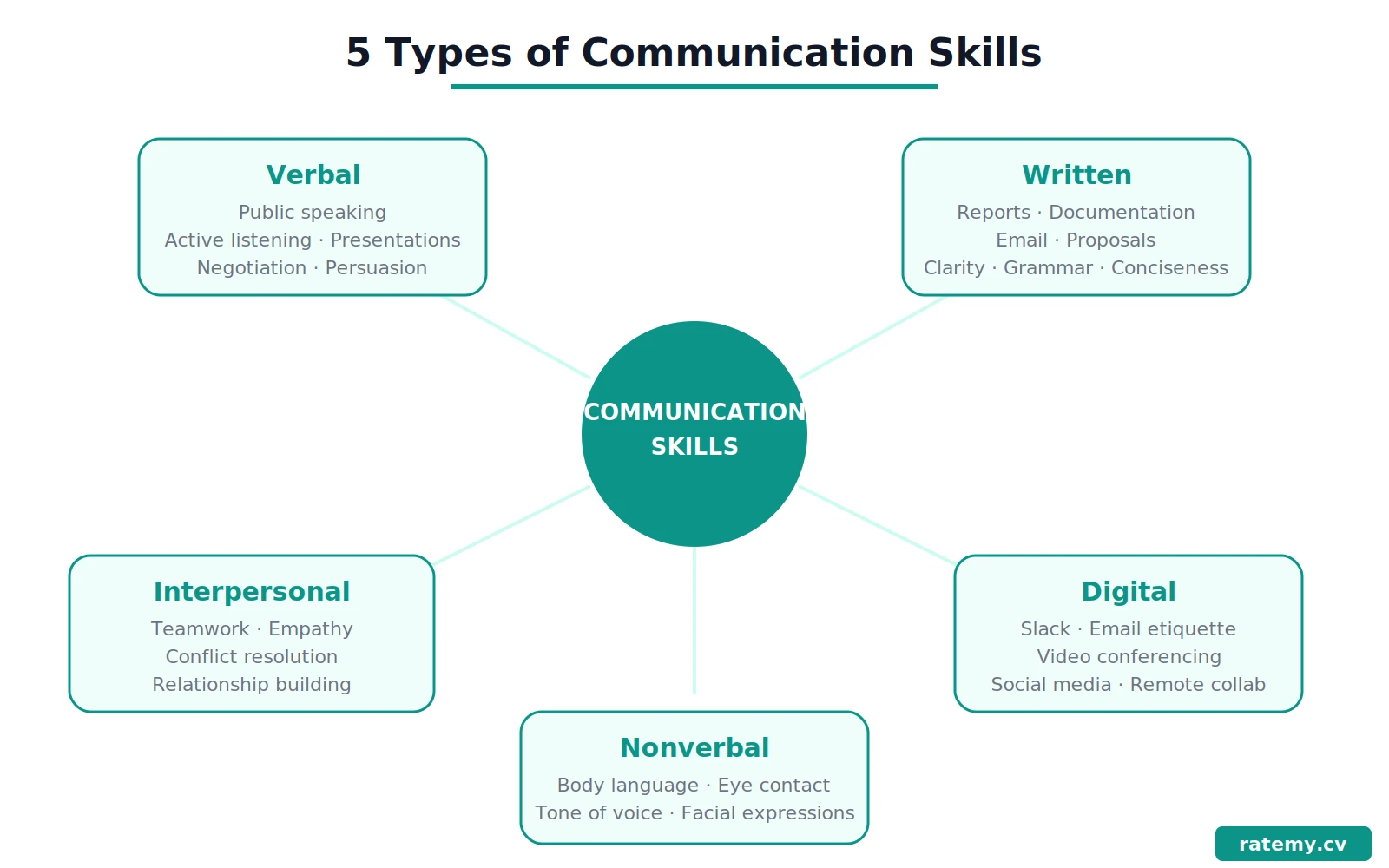
The Five Types of Communication Skills
Different roles weight these differently. A sales job needs strong verbal skills. A remote engineering role needs excellent written communication. A nurse needs empathetic listening. Understanding which type matters most for your target role helps you prioritize what to highlight.
Verbal Communication
Public speaking, presentation delivery, meeting facilitation, phone etiquette, client communication, explaining complex topics in plain language, persuasion, negotiation, interviewing, training and mentoring, storytelling, briefing executives, facilitating brainstorms.
Written Communication
Business writing, email communication, report writing, technical documentation, editing and proofreading, proposal writing, content creation, social media communication, grant writing, policy documentation, writing SOPs, internal communications, regulatory correspondence.
Listening
Active listening, giving constructive feedback, receiving feedback gracefully, empathy, asking clarifying questions, note-taking, summarizing discussions, reading nonverbal cues, patience, open-mindedness.
Interpersonal
Conflict resolution, team collaboration, cross-department communication, stakeholder management, customer service, relationship building, diplomacy, cultural sensitivity, emotional intelligence, networking, client onboarding.
Digital Communication
Video conferencing (Zoom, Teams, Google Meet), Slack and messaging platforms, virtual presentation tools, email management, remote collaboration tools, asynchronous communication, sprint retrospective facilitation, stakeholder update calls.
For more skills across all categories, see our guide on skills to put on your resume.
How to List Communication Skills on Your Resume
There are three places communication skills belong, and the strongest resumes use all three together.
Skills Section — List your 4-5 strongest communication abilities grouped by type. This gives ATS the keyword match and gives human readers a quick snapshot.
SKILLS
Communication: Public speaking, technical writing, cross-functional collaboration, stakeholder presentations
Software: MS Office, Slack, Zoom, Google Workspace
Languages: English (native), Spanish (conversational)
Work Experience Bullets — This is where you turn skills into evidence. Every communication skill you list should appear at least once in your experience section with a number and a result attached.
Summary Statement — Lead with communication if it's central to the role. Example: "Marketing coordinator with 5 years of experience crafting brand messaging. Skilled in presenting campaign strategies to C-level executives and coordinating cross-functional teams to deliver projects on deadline."
Need help with your summary? See our professional summary examples.
Public Speaking — How It Looks on a Resume
Don't write "excellent public speaking skills." Write one of these:
"Presented quarterly product roadmap to 40-person engineering team, securing unanimous buy-in for three priority shifts"
"Delivered 20-minute keynote at regional sales conference (250 attendees), resulting in 15 inbound partnership inquiries"
"Led weekly all-hands meetings for 60-person department, maintaining 92% attendance through engaging format redesign"
"Trained 25 new hires on compliance protocols through interactive workshop format, reducing onboarding errors by 40%"
Each bullet names the audience, the format, and a measurable outcome. That's the difference between a claim and proof.
Conflict Resolution — How It Looks on a Resume
Don't write "strong conflict resolution skills." Write one of these:
"Mediated recurring friction between engineering and design teams, establishing a shared review process that cut revision cycles from 5 rounds to 2"
"De-escalated 30+ customer complaints per week as team lead, maintaining 4.8/5 satisfaction rating during product recall period"
"Resolved interdepartmental resource conflict by facilitating joint planning sessions, recovering 3 weeks of stalled project timeline"
"Addressed vendor disputes through structured negotiation, preserving partnerships worth $200K in annual contracts"
Nonverbal Communication — How to Signal It on a Resume
Body language, facial expressions, eye contact, and tone of voice are harder to list on a resume but just as important in practice. You can signal nonverbal awareness through bullets that describe in-person interactions: "Delivered client presentations to groups of 20+," "Conducted one-on-one coaching sessions with new hires," or "Led in-person stakeholder workshops across 3 office locations." These imply strong presence without writing "good body language."
🎯 Mid-Article Check
Are you listing communication skills — or quantifying them?
Our scanner compares your resume bullets to real job descriptions and shows where you're claiming skills without the evidence to back them up.
Communication Skills by Job Type — With Resume Bullets
Generic skill lists don't help you write better bullets. These role-specific examples show exactly how communication skills appear on resumes that get interviews.
Healthcare
Key skills: Patient communication, clinical charting, interdisciplinary handoffs, family counseling
"Communicated medication changes and care plan updates to patients and families in plain language, reducing post-discharge confusion calls by 25%"
"Delivered concise shift handoff reports to incoming nursing staff, covering 12-15 patients in under 10 minutes with zero missed critical flags"
"Documented patient interactions in Epic EHR with clear clinical notes, cited by supervisor as department model for charting quality"
Education
Key skills: Classroom instruction, parent communication, IEP meetings, curriculum documentation
"Presented student progress reports to parents at 30+ conferences per semester, with 95% parent satisfaction rating"
"Facilitated IEP meetings with parents, administrators, and specialists, ensuring compliance with federal reporting timelines"
"Created weekly classroom newsletter read by 85% of parents, increasing volunteer participation by 40%"
Tech / Engineering
Key skills: Technical documentation, code reviews, stakeholder translation, cross-team alignment
"Authored API documentation adopted as the engineering team standard, reducing developer onboarding questions by 60%"
"Translated complex system architecture decisions into executive-friendly summaries for quarterly board reviews"
"Led code review sessions for 8-person team, providing constructive written feedback that improved merge request quality scores by 30%"
Finance / Accounting
Key skills: Client reporting, regulatory communication, audit presentations, variance explanation
"Prepared and presented monthly financial reports to C-suite leadership, translating variance analysis into strategic recommendations"
"Drafted audit response letters to regulatory bodies, achieving zero follow-up inquiries across 3 consecutive audit cycles"
"Communicated complex tax implications to 50+ small business clients in plain language, earning 98% client retention rate"
Sales
Key skills: Persuasive presentations, negotiation, rapport building, objection handling
"Delivered product demos to enterprise prospects, converting 35% of initial calls into pipeline opportunities worth $2.5M"
"Negotiated contract renewals with 40 accounts, achieving 92% retention and 15% average upsell through consultative dialogue"
"Built executive relationships across 25 accounts through quarterly business reviews, increasing NPS from 42 to 71"
Customer Service
Key skills: Active listening, de-escalation, written follow-up, empathetic communication
"Resolved 150+ customer inquiries weekly across phone, email, and chat, maintaining 4.9/5 satisfaction score"
"De-escalated billing disputes averaging $500+ per case, retaining 85% of at-risk customers through empathetic communication"
"Wrote and implemented 15 response templates adopted company-wide, reducing average reply time from 4 hours to 45 minutes"
Legal
Key skills: Brief writing, client counsel, courtroom communication, contract negotiation
"Drafted 15+ legal briefs per quarter with a 90% favorable ruling rate, noted by partners for clarity and persuasive structure"
"Counseled clients through litigation process, translating legal terminology into plain-language updates that reduced anxiety calls by 35%"
Nonprofit / Social Services
Key skills: Grant writing, community outreach, stakeholder reporting, donor communication
"Wrote 12 grant proposals totaling $800K in funding, with a 75% success rate attributed to clear impact storytelling"
"Presented program outcomes to board of directors quarterly, securing continued funding for 3 community initiatives"
Management / Leadership
Key skills: Performance feedback, meeting facilitation, change communication, executive presentations
"Delivered quarterly performance reviews to 12 direct reports, resulting in 90% of team meeting or exceeding development goals"
"Facilitated weekly cross-department standups between engineering, design, and product (15 participants), reducing duplicate work by 30%"
"Communicated organizational restructuring to 80-person department through town halls and 1:1s, maintaining team retention at 95%"
Remote / Hybrid Roles
Key skills: Asynchronous communication, virtual facilitation, written documentation, proactive updates
"Managed all-remote team of 8 across 4 time zones using structured async updates, maintaining on-time delivery rate of 94%"
"Created internal wiki documenting 40+ team processes, reducing Slack questions by 50% and enabling faster onboarding"
"Facilitated weekly video retrospectives with screen sharing and collaborative Miro boards, maintaining 100% attendance over 6 months"
How to Improve Your Communication Skills
If you want stronger communication evidence on your resume, start documenting your wins now. Every presentation you deliver, every report you write, every conflict you navigate, every stakeholder you align — note it with a number and an outcome. Those become your resume bullets later.
Practical ways to build evidence: volunteer to present at team meetings, write internal documentation that others actually use, lead a cross-functional project, mentor a new team member, or take a public speaking course. The goal is not to claim communication skills — it is to create a track record of them.
Mistakes to Avoid
Listing "good communication skills" without examples — Generic labels mean nothing. Replace every claim with a specific situation and result.
Overloading your resume with soft skills — Balance communication skills with technical and hard skills relevant to the job. A resume full of soft skills and no tools or methods raises questions.
Using the same skills for every application — Tailor your communication highlights to match the job description. A sales role values persuasion and negotiation; a technical role values documentation and stakeholder translation.
Forgetting that your resume IS a writing sample — Typos, unclear phrasing, and generic language in the resume itself contradict any communication claims you make.
Ignoring the job posting's language — If they ask for "client-facing communication," use that exact phrase. ATS matches on specific wording, and so do human readers scanning quickly.
Frequently Asked Questions
How many communication skills should I list on my resume?
List 3-5 in your skills section. More importantly, illustrate 2-3 of them with specific examples in your work experience bullets. Evidence matters more than quantity.
Should I put "excellent communication skills" on my resume?
No. It's vague and overused. Instead, list specific abilities like "public speaking," "technical writing," or "stakeholder management" — and back them up with measurable examples.
What's the best communication skill for a resume?
It depends on the role. For customer-facing jobs: active listening and de-escalation. For leadership: presentation skills and feedback delivery. For remote work: written communication and async collaboration. Match the job description.
How do I show communication skills without work experience?
Use examples from school, volunteering, or personal projects. "Presented senior thesis to panel of 5 professors," "Wrote newsletter for student organization with 500 subscribers," or "Coordinated volunteer team of 10 for community events" all demonstrate real communication ability.
See our guide on writing a resume with no experience for more examples.
✍️ About the Author
Alex Rivers is a resume coach and career advisor who has reviewed over 5,000 resumes and helped job seekers land roles at companies like Google, Amazon, and McKinsey. After years of seeing the same mistakes cost qualified candidates interviews, Alex built ratemy.cv to give everyone access to instant, actionable resume feedback — for free.
Is Your Resume Demonstrating Communication Skills — or Just Listing Them?
Our free scanner reads your resume against any job description and shows you where you're claiming skills without evidence. It takes 30 seconds and doesn't require a signup.
Want to strengthen other parts of your resume? See our guides on action verbs for resume, resume keywords, soft skills for resume, and resume objective examples. Comparing resume tools? See Rate My CV vs Zety and Rate My CV vs Resume Worded.
🎯 How does your resume score?
Paste your resume and a job description — our free scanner shows your match score, missing keywords, and what to fix. Takes 30 seconds.
Scan My Resume — FreeMore in P6: Examples & Skills
Related guides in the same cluster:
- HubSkills to Put on Resume: 100+ Examples That Get Interviews
- Customer Service Resume Examples That Get You Hired (2026)
- Engineering Resume Examples That Land Interviews (2026)
- Nursing Resume Examples That Actually Get Callbacks (2026)
- Teacher Resume Examples That Actually Get Interviews (2026)
- Medical Assistant Resume Examples That Get Hired
- How Many Skills to List on Resume? The Magic Number
- Soft Skills for Resume: 40+ Examples You Can not Leave Out
- Nursing Skills for Resume: What Hospitals Actually Want