
Cloud Computing Skills Resume: What to List (2026)
Every company is a cloud company now — they just differ in how far along the migration is. Startups launch directly on AWS or Google Cloud Platform. Enterprises are halfway through multi-year Azure migrations. Even small businesses run their critical operations on cloud services they do not fully understand. That reality means cloud computing skills are no longer a niche specialty. They show up in job descriptions for cloud engineers, DevOps engineers, data engineers, software developers, security professionals, and increasingly for roles that did not used to touch infrastructure at all.
Where most cloud resumes fail is that "cloud computing" is enormously broad. It covers everything from spinning up an EC2 instance to architecting a multi-region, multi-cloud infrastructure serving millions of users. A resume that just says "Cloud Computing — AWS, Azure, GCP" tells a hiring manager almost nothing. Which services did you use? What did you build? How large was the environment? What problems did your cloud architecture solve?
This guide covers exactly which cloud computing skills to put on your resume, how to write cloud engineer resume bullets that demonstrate real infrastructure experience, which cloud certifications carry weight, and what separates a strong cloud computing resume from one that gets filtered out.
What Is a Cloud Engineer?
A cloud engineer designs, builds, maintains, and optimizes cloud infrastructure and cloud services for an organization. The role spans several specializations: cloud architects design the overall cloud environment, cloud engineers implement and manage it, DevOps engineers automate deployment pipelines, cloud security engineers secure it, and cloud network engineers handle connectivity and performance.
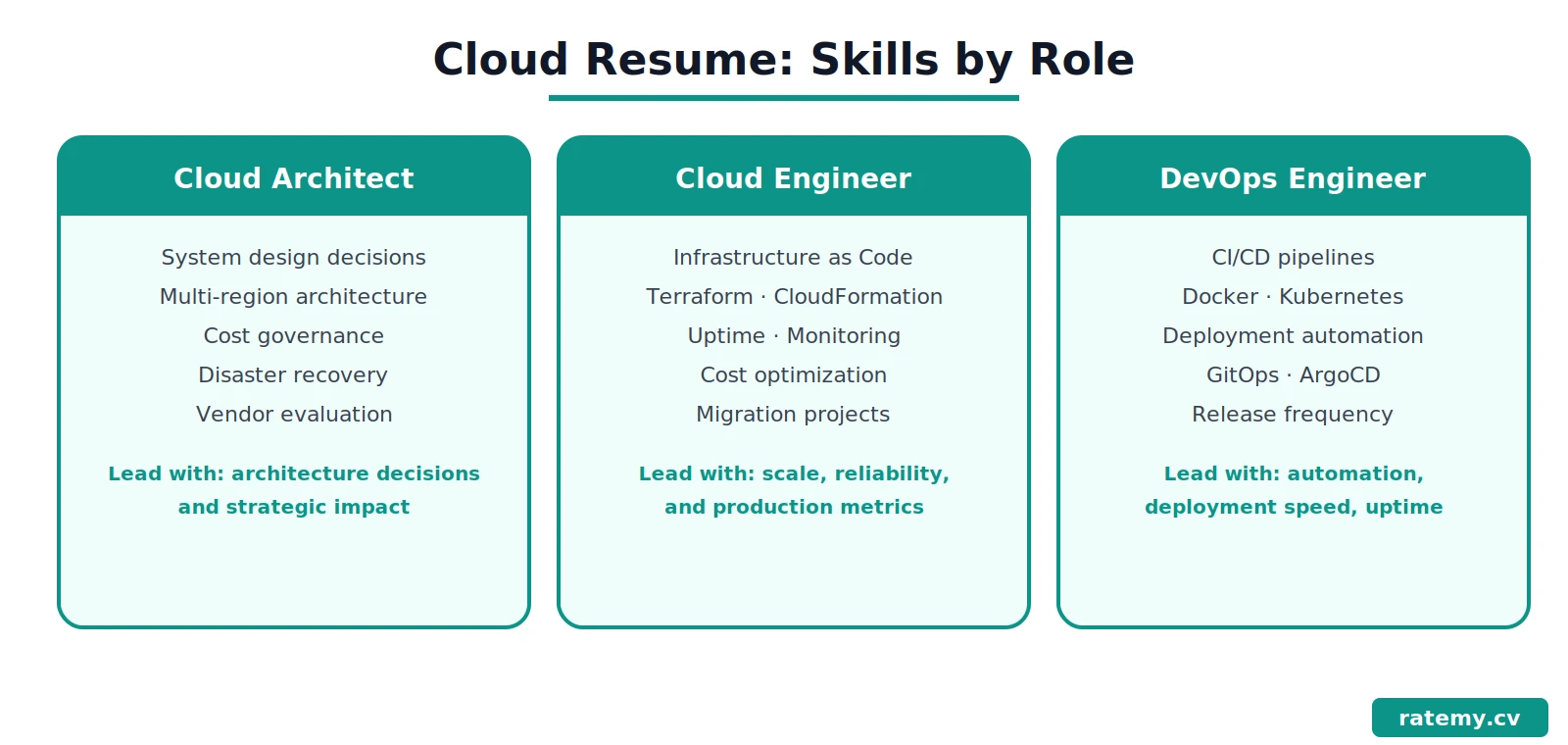
Understanding which type of cloud role you are targeting matters for your resume. A cloud architect resume emphasizes design decisions and system-level thinking. A cloud engineer resume emphasizes hands-on implementation and operations. A DevOps engineer resume emphasizes CI/CD pipelines, infrastructure as code, and automation. Your skills section and experience bullets should reflect the specific cloud engineering role you want — not a generic overview of everything cloud-related.
Top Cloud Computing Skills to List on Your Resume in 2026
AWS (Amazon Web Services)
AWS remains the dominant cloud platform by market share, and it is the most commonly requested cloud skill in job descriptions. But listing "AWS" alone is not enough — specify which services you have worked with and at what scale.
The AWS services that appear most frequently on cloud engineer resumes include EC2, S3, Lambda, RDS, DynamoDB, CloudFormation, ECS/EKS, IAM, VPC, CloudWatch, Route 53, and API Gateway. For data engineering roles, add Redshift, Glue, and Kinesis. For security roles, add GuardDuty, Security Hub, and CloudTrail.
Resume example: Architected and deployed a multi-AZ AWS infrastructure supporting a SaaS platform with 50K daily active users — using EC2 Auto Scaling, RDS Multi-AZ, CloudFront CDN, and S3 for static assets, achieving 99.95% uptime over 18 months.
Microsoft Azure
Azure is the cloud platform of choice for enterprises with existing Microsoft ecosystems. If you have Azure experience, list the specific services: Azure Virtual Machines, Azure Kubernetes Service (AKS), Azure DevOps, Azure Functions, Azure Active Directory, Azure SQL, Cosmos DB, Azure Monitor, and Azure Resource Manager (ARM) templates.
Azure certifications — particularly AZ-900, AZ-104, and AZ-305 — carry significant weight on a cloud computing resume because they demonstrate structured knowledge of the platform.
Resume example: Led migration of 15 on-premises applications to Azure, deploying across AKS and Azure App Service with Azure DevOps CI/CD pipelines — reducing infrastructure costs by 40% and improving deployment frequency from monthly to daily.
Google Cloud Platform (GCP)
GCP is the third major cloud platform and is especially strong in data engineering, machine learning, and analytics roles. Key GCP services for a resume include Compute Engine, Google Kubernetes Engine (GKE), Cloud Functions, BigQuery, Cloud Storage, Cloud Run, Pub/Sub, and Cloud IAM.
If you have GCP experience, highlight it — the talent pool for GCP specialists is smaller than for AWS, which can work in your favor.
Resume example: Built real-time data pipeline on GCP using Pub/Sub, Dataflow, and BigQuery, processing 2M+ events per day from IoT devices and delivering analytics dashboards that reduced equipment downtime by 28%.
Infrastructure as Code (IaC)
Infrastructure as code is one of the most important cloud computing skills for a 2026 resume. It demonstrates that you can manage cloud infrastructure programmatically — not through manual console clicks. The tools that matter most are Terraform (the most widely adopted), AWS CloudFormation, Azure Bicep/ARM templates, Pulumi, and Ansible.
Technical screeners pay close attention to IaC skills because they indicate engineering maturity. A cloud engineer who manages infrastructure through code produces more reliable, repeatable, and auditable environments than one who clicks through the AWS console.
Resume example: Managed entire production infrastructure as code using Terraform (200+ resources across 3 AWS accounts), implementing modular configurations with remote state management and automated plan/apply pipelines via GitHub Actions.
Containerization and Orchestration
Containers have become the standard deployment model for cloud-native applications. Docker and Kubernetes are the two most important technologies in this space. On your resume, describe your container experience in terms of scale, orchestration complexity, and operational outcomes.
Related skills worth listing include Helm charts, container registries (ECR, ACR, GCR), service mesh (Istio, Linkerd), and serverless container platforms (AWS Fargate, Cloud Run, Azure Container Instances).
Resume example: Deployed and managed a 40-node Kubernetes cluster on EKS running 120+ microservices, implementing Helm-based deployments, horizontal pod autoscaling, and Prometheus/Grafana monitoring — handling 10K requests per second at peak.
CI/CD and DevOps Practices
Continuous integration and continuous deployment pipelines are core to modern cloud engineering. Recruiters scan for experience with Jenkins, GitHub Actions, GitLab CI, Azure DevOps, CircleCI, ArgoCD, and Spinnaker. Beyond the tools, describe the practices: automated testing, blue/green deployments, canary releases, rollback strategies, and deployment frequency metrics.
Resume example: Designed CI/CD pipeline using GitHub Actions and ArgoCD for GitOps-based Kubernetes deployments, reducing deployment time from 45 minutes to 8 minutes and enabling the engineering team to ship 30+ releases per week with zero-downtime deployments.
Cloud Security
Cloud security is a specialized and high-demand cloud computing skill. Experience with IAM policies, network security groups, encryption at rest and in transit, secrets management (HashiCorp Vault, AWS Secrets Manager), compliance frameworks (SOC 2, HIPAA, PCI DSS), and security monitoring tools belongs on your resume if you have it.
Cloud security skills are especially valuable because security is often the bottleneck for cloud adoption. Engineers who can build secure cloud environments — not just functional ones — command premium salaries.
Resume example: Implemented cloud security hardening across 5 AWS accounts using IAM least-privilege policies, VPC network segmentation, and automated compliance scanning with AWS Config and Security Hub — achieving SOC 2 Type II certification with zero critical findings.
Reality check: Cloud platforms release new services constantly. Nobody knows all 200+ AWS services. What matters on your resume is depth in the services you have actually used in production, not a long list of services you have read about. Hiring managers can tell the difference in the first 30 seconds of an interview.
Networking and Monitoring
Cloud networking — VPCs, subnets, load balancers, DNS, VPNs, peering, transit gateways — and monitoring — CloudWatch, Datadog, Prometheus, Grafana, ELK stack — are foundational cloud computing skills that many resumes underemphasize. If you have designed network architectures or built observability platforms, describe the scale and the operational outcomes.
Resume example: Designed hub-and-spoke VPC architecture across 4 AWS accounts with Transit Gateway, implementing centralized egress, flow log analysis, and automated alerting that reduced network-related incidents by 80%.
How to Write Cloud Engineer Resume Bullets
Use the Problem → Action → Result Framework
Every effective cloud computing resume bullet answers: what was the infrastructure challenge, what did you build or implement, and what was the measurable result?
Weak: Worked with AWS to deploy cloud infrastructure.
Strong: Migrated legacy monolithic application to AWS ECS with Fargate, breaking it into 8 containerized microservices with independent deployment pipelines — reducing deployment time from 4 hours to 12 minutes and eliminating 3 single points of failure.
Quantify Your Cloud Impact
Cloud engineering work produces measurable outcomes. Metrics that work well include: uptime percentages, cost savings, deployment frequency, infrastructure scale (servers, containers, requests per second), migration scope (applications, databases, users), incident reduction, performance improvements (latency, throughput), and automation coverage.
Entry-level cloud engineer: Provisioned and configured development and staging environments on AWS using Terraform, supporting a 12-person engineering team and reducing environment setup time from 2 days to 30 minutes.
Experienced cloud engineer: Managed production cloud infrastructure serving 2M monthly active users across AWS (EC2, RDS, ElastiCache, S3), maintaining 99.99% uptime and reducing monthly AWS spend by $18K through Reserved Instances and right-sizing analysis.
Senior cloud architect: Designed multi-region active-active architecture on AWS for a fintech platform processing $50M in daily transactions, achieving sub-100ms latency globally and passing all regulatory compliance requirements for PCI DSS and SOC 2.
Where to Put Cloud Computing Skills on Your Resume
Skills Section
Group your cloud skills into clear categories:
Cloud Platforms: AWS (EC2, S3, Lambda, RDS, EKS, CloudFormation), Azure (AKS, Azure DevOps, Azure Functions), GCP (GKE, BigQuery, Cloud Run)
Infrastructure & DevOps: Terraform, Docker, Kubernetes, Helm, Ansible, Jenkins, GitHub Actions, ArgoCD
Monitoring & Security: CloudWatch, Datadog, Prometheus, Grafana, IAM, VPC, Vault, AWS Security Hub
Languages: Python, Bash, Go, YAML, HCL (Terraform)
Networking: VPC Design, Load Balancing, DNS, CDN, Transit Gateway, VPN
Cloud Computing Resume Summary
Your resume summary should immediately communicate your cloud specialization, platform expertise, and impact.
Entry-level cloud engineer resume summary: AWS Certified Cloud Practitioner with hands-on experience provisioning and managing cloud infrastructure using Terraform and Docker. Built and deployed 3 cloud-native applications on AWS during coursework, including a containerized web application serving 1K+ daily requests on ECS Fargate.
Experienced cloud engineer resume summary: Cloud engineer with 5+ years of experience designing and operating production AWS and Azure environments for SaaS and fintech companies. Proficient in Terraform, Kubernetes, CI/CD automation, and cloud security. Track record of maintaining 99.99% uptime, reducing cloud costs by 35%+, and migrating 20+ applications from on-premises to cloud.
Cloud Certifications
Cloud certifications carry significant weight — especially for candidates transitioning into cloud engineering or applying at organizations with formal certification requirements. The most recognized certifications include:
AWS: AWS Certified Cloud Practitioner (entry), AWS Certified Solutions Architect Associate (mid), AWS Certified DevOps Engineer Professional (senior)
Azure: AZ-900 Fundamentals (entry), AZ-104 Administrator (mid), AZ-305 Solutions Architect (senior)
GCP: Cloud Digital Leader (entry), Professional Cloud Architect (mid/senior)
Multi-cloud: Certified Kubernetes Administrator (CKA), HashiCorp Terraform Associate
List certifications near the top of your resume. They are some of the most commonly searched keywords in applicant tracking systems for cloud engineering roles.
Cloud Engineer Resume Examples by Experience Level
Entry-Level Cloud Computing Resume
If you are new to cloud engineering, focus on certifications, personal projects, home lab work, and any professional experience where you touched cloud infrastructure — even if cloud was not your primary role.
What to emphasize: AWS or Azure certifications, Terraform projects, Docker experience, personal cloud deployments, Linux administration, relevant coursework.
Experienced Cloud Engineer Resume
Mid-level cloud engineers should demonstrate production experience — infrastructure you built and operate in live environments. Your resume should show scale, reliability, and cost awareness.
What to emphasize: Production infrastructure scale, uptime metrics, cost optimization results, migration experience, IaC coverage, CI/CD pipeline design, cross-team collaboration.
Senior Cloud Architect Resume
Senior cloud professionals need a resume that shows architectural thinking, strategic decisions, and organizational impact. At this level, you are not just managing cloud services — you are making decisions about which cloud platform to use, how to design for scale and resilience, and how to balance cost against performance.
What to emphasize: Architecture decisions, multi-region design, cost governance, security program design, team mentoring, vendor evaluation, compliance ownership, disaster recovery planning.
Common Mistakes on a Cloud Computing Resume
Listing Platforms Without Services
"AWS, Azure, GCP" in your skills section tells a hiring manager nothing. Specify the services: "AWS (EC2, S3, Lambda, RDS, EKS, CloudFormation)" is infinitely more useful than "AWS."
Ignoring Infrastructure as Code
Many cloud engineers still describe manual console work on their resumes. In 2026, if your resume does not mention Terraform, CloudFormation, or some form of IaC, technical screeners will question whether your cloud practices are production-grade.
No Scale or Uptime Metrics
At the end of the day, cloud engineering is judged by two things: does it stay up, and how painful is it to operate? A resume that describes building cloud infrastructure without mentioning how many users it served, what the uptime was, or what the performance characteristics were is missing the most important evidence.
Burying Certifications
Cloud certifications are hard requirements for many roles. If you hold an AWS Solutions Architect or Azure Administrator certification, it should be prominently displayed — not buried on page two.
Making Your Resume Too Long
A cloud computing resume should be one page for entry-level engineers and no more than two pages for experienced cloud architects. Focus on your most significant cloud projects and strongest metrics.
Cloud Computing Resume FAQs
How do I mention cloud skills on my resume? List specific cloud platforms and services in your skills section, grouped by category. Then demonstrate each in your experience bullets with infrastructure scale, reliability metrics, and business impact. Write "Amazon Web Services (AWS)" in full at least once for ATS matching, then use "AWS" throughout.
What are the most important cloud computing skills? The core skills are: proficiency with at least one major cloud platform (AWS, Azure, or GCP), infrastructure as code (Terraform), containerization (Docker/Kubernetes), CI/CD pipeline design, cloud networking, cloud security fundamentals, and Linux administration. The specific mix depends on the role you are targeting.
Is cloud computing a good skill for a resume in 2026? Yes — cloud computing is one of the highest-demand and highest-paying technical skill sets. Cloud engineering roles consistently rank among the top technology positions in both salary and job availability. Even for roles that are not purely cloud-focused, cloud skills increasingly appear as preferred qualifications.
What cloud certifications should I include on my resume? Start with the foundational certification for your target platform: AWS Certified Cloud Practitioner, Azure AZ-900, or GCP Cloud Digital Leader. Then pursue the associate-level architecture or engineering certification. For experienced professionals, the AWS Solutions Architect Professional or the Certified Kubernetes Administrator (CKA) carry the most weight.
How do I write a cloud computing resume with no experience? Get certified, build projects, and document everything. Deploy a web application on AWS or Azure. Manage the infrastructure with Terraform. Set up a CI/CD pipeline. Monitor it with CloudWatch or Prometheus. Write about what you built, what challenges you solved, and what the infrastructure handles. That project experience — especially if it is on GitHub — is credible evidence on an entry-level cloud computing resume.
Check Your Cloud Computing Resume Now
Not sure if your resume lists the right cloud skills — or if the ATS can even parse your infrastructure experience? Upload your resume and a target job description to see exactly which cloud keywords you are missing.
Run your resume through RateMy.CV → — see exactly what ATS systems and hiring managers see, with specific feedback on missing cloud computing keywords and weak bullets.
The scan takes 30 seconds. Because if you can architect infrastructure for millions of users, your resume should not be the thing that falls over.
Related Resume Skills Guides
🎯 How does your resume score?
Upload your resume and a job description — our free scanner shows your match score, missing keywords, and what to fix. Takes 30 seconds.
Run Your Resume Through RateMy.CV — Free