
Problem-Solving Skills Resume: How to Show Results
Here is the problem with putting "problem-solving skills" on your resume: everybody does it. It has become one of those soft skills that candidates drop into their skills section reflexively, right next to "team player" and "strong communicator." And because everybody lists it, the phrase has lost almost all meaning. Recruiters see it and their eyes slide right past.
That does not mean you should leave problem-solving off your resume. It means you need to prove it instead of just claiming it. The difference between a resume that says "strong problem-solving skills" and one that describes how you diagnosed a production bottleneck, tested three solutions, and reduced downtime by 40% is the difference between getting filtered out and getting the interview.
This guide covers what problem-solving skills actually are, which specific problem-solving abilities employers look for, how to describe problem-solving on your resume with real examples, and why showing beats telling every time.
What Are Problem-Solving Skills?
Problem-solving skills are a set of analytical, creative, and decision-making abilities that allow you to identify problems, evaluate possible solutions, and implement the best course of action. People call them "soft skills," but effective problem solving draws heavily on critical thinking, analytical skills, research, logic, and domain knowledge — none of which feel particularly soft.
Put simply — every company hires people to solve problems. A customer service representative solves customer complaints. A software engineer solves technical challenges. A marketing manager solves acquisition problems. A project manager solves coordination and delivery problems. The skill is universal — but how it shows up on a resume depends entirely on your role and industry.
What makes problem-solving a tricky skill to list on a resume is that it is not a single ability. It is a collection of related skills that work together: identifying the root cause of a problem, gathering and analyzing relevant information, generating potential solutions through brainstorming and creative thinking, evaluating options using logic and data, making decisions under uncertainty, implementing solutions, and measuring results.
Why Do Employers Value Problem-Solving Skills?
Think about it from the employer's perspective. They do not hire people to follow scripts perfectly — they hire people who can handle the situations that no script covers. Every organization faces unexpected challenges: a key client threatens to leave, a product launch hits a technical obstacle, a supply chain disruption threatens deadlines, a team conflict stalls progress.
Employees with strong problem-solving skills handle these moments without escalating everything to their manager. That is why recruiters scan for evidence of problem-solving — not the phrase itself, but the proof that you have faced difficult situations and resolved them effectively.
The most important word in that paragraph is "evidence." Your resume needs to show problem-solving in action, not just assert that you possess the skill.
The Best Problem-Solving Skills for Your Resume
Not all problem-solving skills are equal on a resume. Here are the specific abilities that carry the most weight with hiring managers across industries.
Analytical Thinking
Analytical thinking is the ability to break a complex problem into smaller components, examine each piece, and identify patterns or root causes. On a resume, analytical skills show up when you describe how you diagnosed a problem — not just that you fixed it.
Resume example: Analyzed 6 months of customer churn data to identify that 68% of cancellations occurred within the first 30 days, leading to a redesigned onboarding flow that reduced early churn by 35%.
Critical Thinking
Critical thinking means evaluating information objectively before making decisions — questioning assumptions, considering multiple perspectives, and distinguishing correlation from causation. Recruiters look for critical thinking skills when they need someone who will not just accept the first solution that presents itself.
Resume example: Challenged the team's assumption that declining conversion rates were caused by pricing, conducted A/B testing that revealed a checkout UX issue, and implemented a fix that recovered $180K in quarterly revenue.
Decision-Making Under Pressure
Many of the most valuable problem-solving moments happen under time pressure. If you have made decisions in high-stakes situations — production outages, client escalations, budget shortfalls, compliance deadlines — describe the situation, the constraints, and the outcome on your resume.
Resume example: Led rapid response to a data breach affecting 12,000 customer records, coordinating cross-functional team to contain the incident within 3 hours, notify affected users within 24 hours, and implement preventive security measures that passed subsequent compliance audit.
Creative Problem Solving
Creative problem solving means generating solutions that are not obvious — approaches that require lateral thinking, innovation, or unconventional methods. This skill is especially valued in product development, marketing, design, and startup environments.
Resume example: Developed a peer-mentorship matching system to address a 40% drop in new employee retention, pairing 120 new hires with experienced team members — improving 90-day retention from 62% to 89% without increasing HR headcount.
Research and Data-Driven Problem Solving
Some problems require gathering information before you can solve them. Research skills — knowing what data to collect, where to find it, and how to interpret it — are a critical part of the problem-solving process that many resumes overlook.
Resume example: Researched competitor pricing strategies across 15 markets, built a comparative analysis in Excel, and recommended a tiered pricing model that increased average deal size by 22% without reducing win rate.
Reality check: Listing "problem-solving" in your skills section is not wrong — ATS systems do search for the phrase. But it adds almost zero value on its own. The real work is in your experience bullets, where you show the problem, your approach, and the result. That is what makes a hiring manager stop scanning and start reading.
Communication and Stakeholder Management
Solving a problem means nothing if you cannot explain the solution to others and get buy-in. Communication skills — presenting findings, writing reports, persuading stakeholders, translating technical issues into business language — are an essential part of the problem-solving process.
On your resume, describe situations where you not only solved a problem but communicated the solution in a way that influenced decisions or changed direction.
Resume example: Identified a $340K annual overspend in software licensing through vendor audit, presented findings and renegotiation strategy to CFO, and led vendor negotiations that reduced SaaS costs by 28%.
How to Describe Problem-Solving Skills on Your Resume
Stop Listing — Start Proving
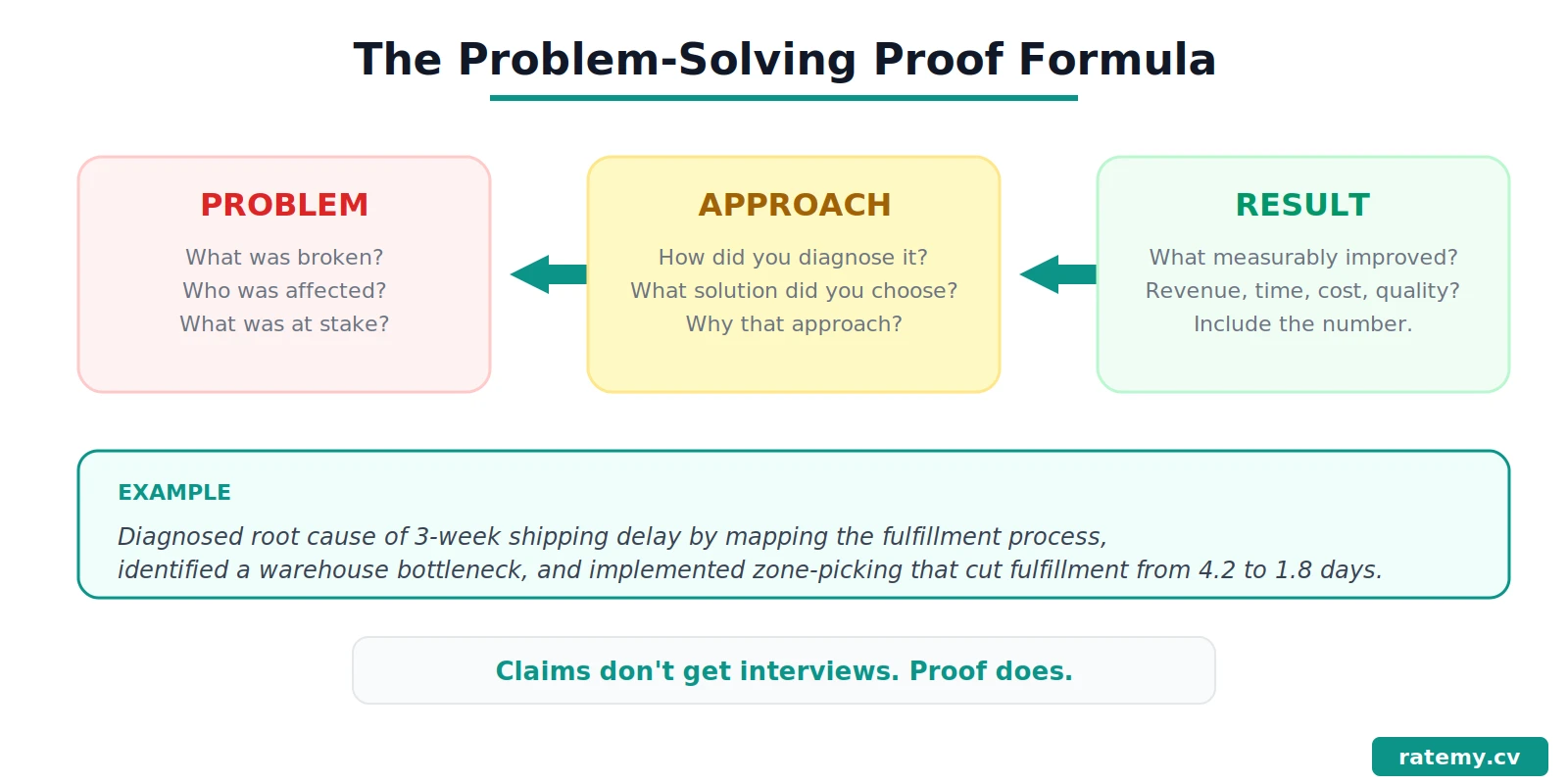
The single most important rule for problem-solving skills on a resume: do not just list "problem-solving" as a skill. Prove it through your experience bullets. Every strong problem-solving resume bullet follows a clear structure:
The Problem: What was broken, underperforming, or at risk?
Your Approach: How did you analyze the problem and decide on a solution?
The Result: What measurable outcome did your solution produce?
This is the difference between a buzzword and a proof point.
Weak: Strong problem-solving and analytical skills.
Strong: Diagnosed root cause of a 3-week shipping delay by mapping the full order fulfillment process, identified a bottleneck in warehouse staging, and implemented a zone-picking system that reduced average fulfillment time from 4.2 days to 1.8 days.
Use Strong Problem-Solving Action Verbs
The verbs you use on your resume signal whether you actually solved problems or just participated in them. Replace passive language with active, problem-solving verbs:
Analysis verbs: Diagnosed, Investigated, Analyzed, Assessed, Identified, Evaluated, Audited, Mapped, Researched, Benchmarked
Solution verbs: Resolved, Redesigned, Developed, Engineered, Implemented, Streamlined, Automated, Restructured, Optimized, Overhauled
Impact verbs: Reduced, Increased, Eliminated, Improved, Recovered, Saved, Prevented, Accelerated, Strengthened, Delivered
Avoid vague verbs like "helped," "assisted," "participated in," or "was responsible for." These hide your contribution rather than highlighting it.
Quantify the Problem and the Solution
Numbers make problem-solving tangible. Whenever possible, quantify both the problem (what was wrong) and the result (what improved). This gives recruiters concrete evidence of your impact.
By role type:
Customer service: Resolved average of 45 customer escalations per week with a 94% first-contact resolution rate, reducing repeat contacts by 30% and improving CSAT scores from 3.8 to 4.5.
Operations: Identified recurring inventory discrepancies costing $85K annually through data analysis and process mapping, implemented barcode verification system that reduced errors by 92%.
Engineering: Debugged intermittent production crash affecting 5% of users, traced root cause to a race condition in the authentication service, and deployed fix that eliminated the issue — reducing error tickets from 200/week to zero.
Marketing: Diagnosed a 40% drop in email open rates through segmentation analysis, discovered that a list merge had corrupted subscriber preferences, and rebuilt segments that restored open rates to 28% within one campaign cycle.
Management: Resolved a cross-team conflict between engineering and product that had stalled a feature launch for 6 weeks by facilitating a structured prioritization workshop, resulting in an agreed roadmap and on-time delivery.
Where to List Problem-Solving Skills on Your Resume
Skills Section
Include "Problem Solving" and related analytical skills in your skills section — the ATS needs to find the keyword. But group it with specific, less generic skills to add context:
Analytical & Problem-Solving: Problem Solving, Critical Thinking, Root Cause Analysis, Data-Driven Decision Making, Process Improvement, Risk Assessment
This is more credible than listing "Problem Solving" alone next to "Microsoft Office."
Resume Summary
Your resume summary is a strong place to signal problem-solving ability — if you do it with specificity rather than buzzwords.
Weak: Results-driven professional with strong problem-solving skills.
Strong: Operations manager with 6+ years of experience solving complex supply chain and fulfillment problems for e-commerce companies. Track record of reducing costs by 20%+ through process redesign, data analysis, and cross-functional collaboration.
Experience Bullets (Most Important)
This is where problem-solving skills actually live on your resume. Every experience section should contain at least 1-2 bullets that demonstrate you identified a problem, developed a solution, and delivered a measurable result. These bullets are the evidence that makes the skills section credible.
Problem-Solving Skills Resume Examples by Industry
Technology and Engineering
Solved a recurring database timeout issue affecting 15K daily users by profiling query execution plans, identifying 3 unindexed joins, and implementing database optimizations that reduced average query time from 4.2 seconds to 0.3 seconds.
Healthcare
Addressed a 25-minute average patient wait time by analyzing appointment scheduling patterns, identifying overbooking during peak hours, and implementing a staggered scheduling model that reduced wait times to under 10 minutes.
Finance
Identified a $1.2M reconciliation discrepancy through systematic audit of intercompany transactions, traced the error to a legacy system mapping issue, and developed an automated reconciliation check that prevented recurrence.
Customer Service
Recognized a pattern of repeat calls about billing errors, investigated the root cause in the invoicing system, and worked with engineering to deploy a fix that reduced billing-related support tickets by 60%.
Marketing
Solved a lead quality problem by analyzing conversion data across 8 campaigns, discovering that gated content attracted high-volume but low-intent leads, and shifting strategy to bottom-of-funnel content that improved SQL rate by 45%.
How to Improve Your Problem-Solving Skills
If you want stronger problem-solving examples on your resume, start documenting your problem-solving work now. Every time you face a challenge at work — whether you solve it alone or as part of a team — note the problem, your approach, and the outcome. This creates a library of resume-ready bullets.
You can also improve problem-solving skills through structured practice: case study competitions, cross-functional projects, process improvement initiatives, root cause analysis exercises, and mentoring situations where you help others think through problems.
The key is moving from "I fixed things" to "I can explain what I fixed, why it was broken, and what the outcome was." That is the thinking that translates directly into strong resume bullets.
Common Mistakes When Listing Problem-Solving Skills on a Resume
Just Writing "Problem-Solving Skills"
This is the most common mistake. The phrase alone is a buzzword. It needs evidence in your experience section to mean anything.
Being Too Vague About the Problem
"Solved various operational problems" could describe anyone. Specify the problem: what was broken, who was affected, what was the scale, what was at stake.
Forgetting the Result
Many resumes describe the problem and the action but forget the outcome. If you fixed something but cannot describe what improved, the bullet loses most of its impact. Always end with a measurable result.
Listing Problem-Solving Only in the Skills Section
The skills section is for the ATS. The experience section is for the hiring manager. If "problem-solving" appears only in your skills list and never in your experience bullets, it looks like a claim without evidence.
Problem-Solving Skills Resume FAQs
How do you describe problem-solving on a resume? Describe a specific problem you faced, the approach you took to solve it, and the measurable result. Use active verbs like "diagnosed," "resolved," "identified," and "implemented." Avoid generic phrases like "strong problem-solving skills" — show the skill through concrete examples in your experience bullets.
Should I put problem-solving skills on my resume? Yes — include "Problem Solving" in your skills section for ATS matching, but more importantly, demonstrate it through your experience bullets. The phrase in the skills section gets you past the filter; the evidence in your bullets gets you the interview.
Is problem-solving a soft skill? Yes. Problem-solving is classified as a soft skill because it involves judgment, creativity, and adaptability rather than a specific technical tool. However, effective problem-solving often requires hard skills too — data analysis, research, technical knowledge — which is why the best resume bullets combine both.
What are some examples of problem-solving skills? Specific problem-solving skills include: analytical thinking, critical thinking, creative problem solving, root cause analysis, decision-making, research, data analysis, process improvement, risk assessment, communication, and interpersonal skills for collaborative problem solving. The strongest resumes demonstrate these through specific work examples rather than listing them as labels.
How do I show problem-solving skills if I am entry-level? Draw from academic projects, internships, volunteer work, part-time jobs, and personal situations. Every job involves problems — even entry-level roles. Describe a customer complaint you resolved, a process you improved, or a challenge you overcame during a group project. Frame it with the problem-action-result structure and it becomes a legitimate resume bullet.
Check Your Problem-Solving Resume Now
Not sure if your resume proves your problem-solving skills — or just claims them? Upload your resume and a target job description to see exactly where your bullets need stronger evidence and which problem-solving keywords are missing.
Run your resume through RateMy.CV → — see exactly what ATS systems and hiring managers see, with specific feedback on vague bullets and missing keywords.
The scan takes 30 seconds. Because the best problem solvers do not guess — they measure.
Related Resume Skills Guides
🎯 How does your resume score?
Upload your resume and a job description — our free scanner shows your match score, missing keywords, and what to fix. Takes 30 seconds.
Run Your Resume Through RateMy.CV — Free