
Data Analysis Skills Resume: What to List (2026)
Your resume has about seven seconds to convince a hiring manager that you belong in the "yes" pile. For data analysts, those seconds hinge on whether your data analysis skills come through clearly — not buried in a wall of buzzwords, but demonstrated with evidence a recruiter can verify in a quick scan.
The challenge is that "data analysis" covers an enormous range. SQL queries, Python scripts, Tableau dashboards, Excel pivot tables, statistical modeling, data visualization, data cleansing — the skills list for a data analyst role can feel endless. And every job description asks for a slightly different combination.
This guide breaks down exactly which data analysis skills to put on your resume, where to place them, how to write experience bullets that prove proficiency, and what mistakes cost data analysts interviews in 2026.
What Counts as a Data Analysis Skill on a Resume?
Data analysis skills fall into two categories that both need to appear on your resume: technical skills (the tools and languages you use to work with data) and soft skills (how you communicate findings and drive decisions).
Technical skills are the ones ATS systems scan for first. These include programming languages like Python, R, and SQL; data visualization tools like Tableau, Power BI, and Google Looker Studio; spreadsheet tools like Microsoft Excel (including pivot tables, VLOOKUP, and macros); database management with MySQL, PostgreSQL, or Snowflake; statistical analysis and probability; machine learning fundamentals; and data cleansing and data processing techniques.
Soft skills matter because a data analyst who cannot explain their findings is just someone running queries. The soft skills hiring managers look for include storytelling with data, communication across technical and non-technical audiences, problem solving, critical thinking, analytical thinking, attention to detail, and decision-making support.
A strong data analyst resume blends both. The skills section catches the ATS. The experience section proves you can actually turn complex data into actionable insights.
Top Data Analyst Skills to List on Your Resume in 2026
Not every skill carries equal weight. Here are the ones that appear most consistently in data analyst job descriptions and carry the most value on a resume right now.
SQL and Database Skills
SQL remains the single most requested skill in data analyst job descriptions. Nearly every data analyst role requires you to write queries, join tables, filter data sets, and pull information from relational databases. If you only list one technical skill, make it SQL.
Beyond basic SELECT statements, recruiters scan for experience with complex queries — window functions, subqueries, CTEs, and query optimization. Mention the specific database platforms you have worked with: PostgreSQL, MySQL, SQL Server, Snowflake, or Amazon Web Services (Redshift).
Resume example: Wrote and optimized 50+ SQL queries across PostgreSQL and Snowflake databases, reducing average report generation time from 12 minutes to under 90 seconds for a data set of 4M+ rows.
Python and R for Data Analysis
Python has become the default programming language for data analysis and data science. Technical screeners look for analysts who can go beyond Excel — using pandas for data manipulation, NumPy for numerical computation, and libraries like matplotlib or seaborn for data visualization.
R is still valued in research-heavy industries like healthcare, finance, and academia where statistical analysis is the primary focus. If the job description mentions R, include it. If it does not, lead with Python.
On your resume, do not just write "Python." Specify the libraries and what you used them for. This signals depth rather than surface-level familiarity.
Resume example: Built automated data processing pipeline in Python (pandas, NumPy) that cleaned and standardized 200K+ customer records weekly, eliminating 15 hours of manual data cleansing per month.
Data Visualization and Dashboard Tools
Data visualization is where analysis meets communication. Analytics leads care about whether you can turn raw data into clear, actionable dashboards that non-technical stakeholders can understand and use for decision-making.
The main tools to list on a data analyst resume are Tableau, Microsoft Power BI, and Google Looker Studio. Excel charts also count, but standalone visualization tools carry more weight for mid-level and senior data analyst roles.
When listing data visualization on your resume, always mention what the dashboard tracked and who used it. A dashboard that nobody looks at is not an achievement.
Resume example: Designed executive Tableau dashboard tracking 12 KPIs across sales, marketing, and operations — adopted by C-suite for weekly strategy meetings, replacing a 40-page PDF report.
Microsoft Excel (Advanced)
Do not underestimate Excel on a data analyst resume. Many hiring managers — especially outside of tech — still consider Excel proficiency a core requirement. But "proficient in Excel" is meaningless on a resume. Specify what you actually do in Excel: pivot tables, VLOOKUP/XLOOKUP, conditional formatting, Power Query, macros, VBA automation, data modeling, and complex formulas.
Excel is especially important for entry-level data analyst resumes where you may not yet have deep experience with Python or SQL. It signals that you can work with data effectively even without specialized tools.
Resume example: Built Excel-based forecasting model using pivot tables and Power Query, processing 18 months of sales data across 6 product lines to project quarterly revenue within 3% accuracy.
Statistics and Analytical Skills
Understanding statistics is what separates a data analyst from someone who just knows how to use software. Team leads notice evidence of statistical thinking: hypothesis testing, regression analysis, probability, A/B testing, and exploratory data analysis.
You do not need a statistics degree to demonstrate these analytical skills on your resume. What matters is showing that you applied statistical methods to solve a real business problem and that the result influenced a decision.
Resume example: Conducted A/B test analysis on checkout flow redesign using chi-square testing, identifying a statistically significant 8% improvement in conversion rate (p < 0.05) that was rolled out company-wide.
Data Science and Machine Learning Fundamentals
For senior data analyst roles and positions that bridge data analysis and data science, listing machine learning fundamentals can set your resume apart. This does not mean you need to build production ML models — but showing familiarity with algorithms like linear regression, classification, clustering, and basic NLP demonstrates that you can handle more complex analytical work.
If you have experience with scikit-learn, TensorFlow, or PyTorch, include them. If you have built predictive models — even simple ones — describe the business outcome they produced.
Resume example: Developed customer churn prediction model using scikit-learn (logistic regression), achieving 84% accuracy and enabling the retention team to proactively target 2,300 at-risk accounts per quarter.
Reality check: Most recruiters do not care how many tools you know. They care whether you can take messy, incomplete data and turn it into a decision someone is willing to act on. Every skill you list should point back to that.
Cloud Computing and Big Data Tools
As data sets grow larger, cloud computing skills are increasingly expected on data analyst resumes. Familiarity with Amazon Web Services (S3, Redshift, Athena), Google Cloud (BigQuery), or Microsoft Azure signals that you can work with data at scale — not just on your laptop.
For analysts working with big data, tools like Apache Spark, Hadoop, and Airflow for workflow orchestration are worth listing if the job description mentions them.
Resume example: Migrated legacy reporting pipeline to AWS Redshift + Airflow, enabling the analytics team to query 500M+ row data sets in under 10 seconds — a 20x improvement over the previous on-premise SQL Server setup.
How to Write Data Analyst Resume Bullets That Stand Out
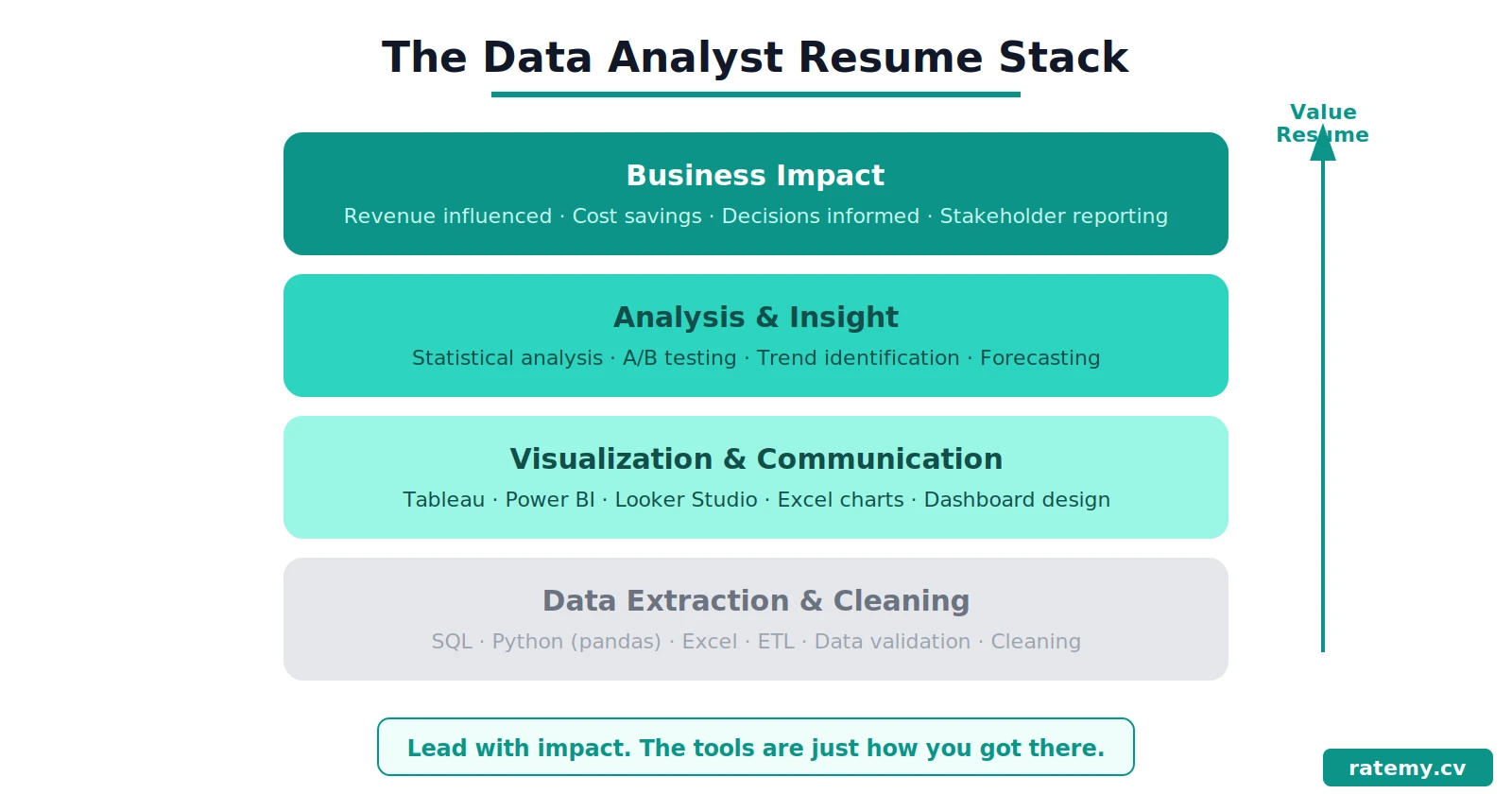
Listing skills in a skills section gets you past the ATS. But hiring managers make their decision based on your experience bullets. Here is how to write data analyst resume bullets that actually stand out.
Use the PAR Formula: Problem → Action → Result
Every strong resume bullet follows this structure: what was the problem, what did you do, and what was the measurable result? This is the difference between a resume that describes responsibilities and one that demonstrates value.
Weak: Responsible for data analysis and reporting.
Strong: Analyzed 3 years of customer purchase data using SQL and Python, identifying cross-sell opportunities that generated $420K in incremental revenue over two quarters.
The weak version could describe anyone. The strong version is specific, quantified, and tied to a business outcome that a hiring manager can evaluate.
Quantify Everything You Can
Data analysts work with numbers. Your resume should reflect that. Include metrics wherever possible: percentages, dollar amounts, time saved, records processed, accuracy improvements, data set sizes, number of stakeholders served.
If you cannot remember the exact number, estimate conservatively. "Reduced report generation time by approximately 60%" is infinitely more powerful than "Improved reporting efficiency."
Here are examples of strong quantified bullets for different experience levels:
Entry-level data analyst: Cleaned and validated 50K+ survey responses in Excel, identifying and correcting 1,200 duplicate entries that were skewing customer satisfaction scores by 4 percentage points.
Experienced data analyst: Built automated anomaly detection system in Python that flagged 95% of data quality issues within 30 minutes of ingestion, down from a 48-hour manual review cycle.
Senior data analyst: Led cross-functional analytics initiative across marketing, product, and finance teams, delivering a unified customer data platform that reduced conflicting reports by 80% and saved 120+ analyst hours per month.
Match the Job Description Keywords
Every data analyst job description contains specific keywords that the ATS will scan for. Your resume needs to include those exact terms — not synonyms or abbreviations. If the job description says "data visualization," do not just write "charts." If it says "SQL Server," do not just write "SQL."
Read the job description carefully and map each required skill to a specific bullet or mention in your resume. This is the single most effective way to increase your interview rate.
You can check your resume against any job description for free to see exactly which keywords you are missing and which ones you have covered.
Where to Put Data Analysis Skills on Your Resume
The placement of your data analysis skills matters almost as much as the skills themselves. Here is the structure that works best for data analyst resumes.
Skills Section
Create a dedicated skills section near the top of your resume. Group your data analysis skills into clear categories:
Data & Analytics: SQL, Python, R, pandas, NumPy, Excel (pivot tables, Power Query, VBA), Statistics, A/B Testing
Visualization: Tableau, Power BI, Looker Studio, matplotlib, seaborn
Databases: PostgreSQL, MySQL, Snowflake, Redshift, BigQuery
Tools & Platforms: Git, Jupyter Notebook, Google Analytics, Airflow, dbt, AWS
This makes it easy for both the ATS and the recruiter to find what they need. Avoid rating your skills with stars, bars, or percentages — they add no information and waste space.
Resume Summary or Objective
Your resume summary is the first thing a hiring manager reads. For data analysts, it should immediately communicate your experience level, core technical skills, and the type of impact you deliver.
Entry-level data analyst resume summary: Recent analytics graduate with hands-on experience in SQL, Python, and Tableau. Completed 3 data analysis projects using real-world data sets, including a customer segmentation analysis that identified 4 distinct buyer personas for a retail startup.
Experienced data analyst resume summary: Data analyst with 4+ years of experience turning complex data into actionable insights for SaaS and e-commerce companies. Proficient in SQL, Python (pandas, scikit-learn), Tableau, and Power BI. Track record of building dashboards and analytics pipelines that have influenced $2M+ in business decisions.
Work Experience Section
This is where you prove your skills section is not fiction. Each role should contain 3 to 5 bullets, with the strongest and most relevant bullet first. Lead with your biggest data analysis achievement, not your daily responsibilities.
For each bullet, include at least one technical skill by name and at least one quantified result. This gives the ATS a keyword match and gives the recruiter a reason to call you.
Education and Certifications
For data analyst roles, relevant certifications can strengthen your resume — especially if you are transitioning into data analysis from another field. The most recognized ones include Google Data Analytics Professional Certificate, IBM Data Analyst Professional Certificate, Microsoft Certified: Data Analyst Associate (Power BI), and Tableau Desktop Specialist.
List certifications below your education section. If you have a degree in a quantitative field (statistics, mathematics, computer science, economics), make sure it is visible — it signals analytical thinking to hiring managers who screen quickly.
Data Analyst Resume Examples by Experience Level
Entry-Level Data Analyst Resume
If you are writing an entry-level data analyst resume with limited work experience, focus on projects, coursework, and internships. Hiring managers know you will not have five years of SQL experience. What they want to see is that you can work with data, draw conclusions, and communicate findings.
Include academic projects, personal data analysis projects, freelance work, and any experience where you used data to inform a decision. A personal blog where you analyze election data, sports statistics, or financial trends counts as legitimate experience.
What to emphasize: Python or R projects, SQL coursework, Excel proficiency, data visualization projects, statistics coursework, any analytics internship experience.
Experienced Data Analyst Resume
Mid-level data analyst resumes should focus on impact and complexity. You have moved past the "can you use the tools" stage — now analytics leads want to know if you can handle complex data, build scalable solutions, and influence business decisions.
What to emphasize: Cross-functional collaboration, dashboard adoption metrics, pipeline automation, data quality improvements, mentoring junior analysts, domain knowledge in your industry.
Senior Data Analyst Resume
Senior data analyst resumes should demonstrate leadership, strategic thinking, and business impact. At this level, the technical skills are assumed — what differentiates you is your ability to frame data analysis as a business function, not just a technical one.
What to emphasize: Revenue impact, cost savings, team leadership, stakeholder management, analytics strategy, data governance, cross-team initiatives.
Common Mistakes on a Data Analyst Resume
Listing Tools Without Context
The most common mistake on a data analyst resume is listing a wall of tools — SQL, Python, R, Tableau, Power BI, Excel, SAS, SPSS, Hadoop — without any evidence that you have used them meaningfully. A skills list without corresponding experience bullets looks like you copied it from a job description.
For every tool in your skills section, you should have at least one experience bullet that references it. If you cannot write a bullet about it, remove it from your skills list.
Writing Vague Bullets
"Performed data analysis to support business decisions" tells a hiring manager nothing. What data? What analysis? What decisions? Data analyst resume bullets need specifics: the data set size, the methodology, the tool, and the outcome.
Ignoring the Job Description
Every data analyst job description is different. A financial analyst role emphasizes different skills than a marketing data analyst or a healthcare data analyst. Submitting the same generic resume to every application means your resume will match some job descriptions well and most of them poorly.
Tailor your resume for each application. Move the most relevant skills and experience to the top. Mirror the exact language from the job description. This takes 15 minutes and dramatically increases your chances of getting past the ATS.
Making Your Resume Too Long
A data analyst resume should ideally be one page for entry-level and early-career professionals, and no more than two pages for experienced and senior data analysts. If your resume is three pages long, you are including too much. Cut the older experience, remove irrelevant skills, and tighten your bullets.
How to Format a Data Analyst Resume (ATS-Friendly Tips)
ATS compatibility is non-negotiable for data analyst resumes. Here are the formatting rules that ensure your resume gets parsed correctly:
Use a clean, single-column layout. Multi-column resumes, tables, and text boxes frequently break ATS parsing. Use standard section headers: "Skills," "Experience," "Education," and "Certifications." Avoid headers like "My Toolkit" or "What I Bring" — ATS systems may not recognize them.
Save your resume as a PDF or DOCX file. PDF preserves formatting; DOCX is universally parsed. Avoid images, charts, icons, or graphics in the resume itself — ATS systems cannot read them. Use a standard font like Calibri, Arial, or Garamond at 10-11pt.
Include the full name of tools and technologies, not just abbreviations. Write "Microsoft Excel" at least once, not just "Excel." Write "Structured Query Language (SQL)" in your summary if space allows, then use "SQL" throughout.
Resume FAQs for Data Analysts
How do I mention data analyst skills in my resume? List your technical skills (SQL, Python, Tableau, Excel) in a dedicated skills section grouped by category. Then demonstrate each skill in your work experience bullets with specific examples and measurable results. The skills section gets you past the ATS; the experience section convinces the hiring manager.
What are the top 3 skills for a data analyst? SQL, Python, and data visualization (Tableau or Power BI). These three appear in the vast majority of data analyst job descriptions and cover the core workflow: extracting data, analyzing it, and presenting findings.
Is data analysis a technical skill? Yes. Data analysis is classified as a technical or hard skill because it requires specific knowledge of tools, methodologies, and analytical techniques that can be measured and tested. However, applying data analysis effectively also requires soft skills like communication, problem solving, and storytelling.
Do I need a cover letter when applying for data analyst roles? A strong cover letter can help, especially for competitive roles or when you are transitioning into data analysis from another field. Use it to explain context that your resume cannot — why you are interested in data, what problems you want to solve, and how your experience connects to the specific role.
What if I don't have much experience in data analysis? Focus on projects, coursework, and transferable skills. Build 2-3 portfolio projects using publicly available data sets (Kaggle is a good starting point). Write up your methodology and findings. These demonstrate your analytical skills even without formal work experience. Many entry-level data analysts land their first role based on project work alone.
Should I include a portfolio with my resume? Yes, if you have one. A portfolio with documented data analysis projects — especially ones hosted on GitHub or a personal blog — gives hiring managers concrete evidence of your skills. Include a link in your resume header, next to your LinkedIn profile and email.
Check Your Data Analyst Resume Now
Not sure if your resume lists the right data analysis skills — or lists them in the right way? Upload your resume and a target job description, and get an instant ATS score with specific feedback on missing keywords, weak bullets, and formatting issues.
Run your resume through RateMy.CV → — see exactly what ATS systems and hiring managers see, with specific feedback on missing keywords, weak bullets, and formatting issues.
The scan takes 30 seconds and gives you a clear action plan for making your data analyst resume stronger before you submit your next application.
Related Resume Skills Guides
🎯 How does your resume score?
Upload your resume and a job description — our free scanner shows your match score, missing keywords, and what to fix. Takes 30 seconds.
Run Your Resume Through RateMy.CV — Free