
Prompt Engineering Resume: AI Skills That Get Hired
Two years ago, "prompt engineer" sounded made up. Today it appears in job descriptions — and real salary bands — across technology, marketing, product management, consulting, and data science. Companies building with generative AI need people who can design, test, optimize, and scale prompts that make large language models produce reliable, high-quality outputs — and they are willing to pay well for that skill.
But prompt engineering on a resume is tricky. The field is so new that hiring managers disagree on what counts as real prompt engineering experience. Listing "ChatGPT" in your skills section does not impress anyone — every knowledge worker uses ChatGPT now. The candidates who get interviews are those who demonstrate that they have built systems around AI prompts: designed prompt chains, evaluated model performance, reduced hallucinations, improved output consistency, and integrated AI into production workflows.
This guide covers exactly how to add prompt engineering to your resume, which AI skills employers actually look for, how to write resume bullets that prove real proficiency with large language models, and what makes a prompt engineer resume stand out in 2026.
What Does a Prompt Engineer Do?
A prompt engineer designs, tests, and optimizes the instructions given to large language models (LLMs) like GPT-4, Claude, Gemini, and open-source models to produce accurate, consistent, and useful outputs. In practice, prompt engineering lives somewhere between software engineering, applied linguistics, and domain expertise.
Day-to-day responsibilities vary widely depending on the organization. Some prompt engineers work on customer-facing AI products — writing system prompts, building prompt chains, and testing edge cases. Others focus on internal AI applications — automating workflows, building AI-powered tools, or improving content generation pipelines. Some roles are standalone "Prompt Engineer" positions; others embed prompt engineering skills into broader AI engineer, data scientist, or product manager roles.
Understanding where prompt engineering fits in the organization you are targeting helps you tailor your resume. A startup hiring its first AI prompt engineer wants a generalist who can do everything. A large company with an established AI team wants a specialist who can optimize model performance at scale.
Top Prompt Engineering Skills to List on Your Resume in 2026
Prompt Design and Optimization
This is the core skill. Prompt design means crafting instructions that consistently get the desired output from a language model — and prompt optimization means iterating on those instructions to improve accuracy, reduce token usage, and handle edge cases.
On your resume, go beyond "wrote prompts." Describe the techniques you used: few-shot prompting, chain-of-thought reasoning, role-based prompting, prompt chaining, prompt compression, and structured output formatting (JSON, XML, markdown). Specify which models you worked with — GPT-4, Claude, Gemini, Llama, Mistral — because each model responds differently to prompt strategies.
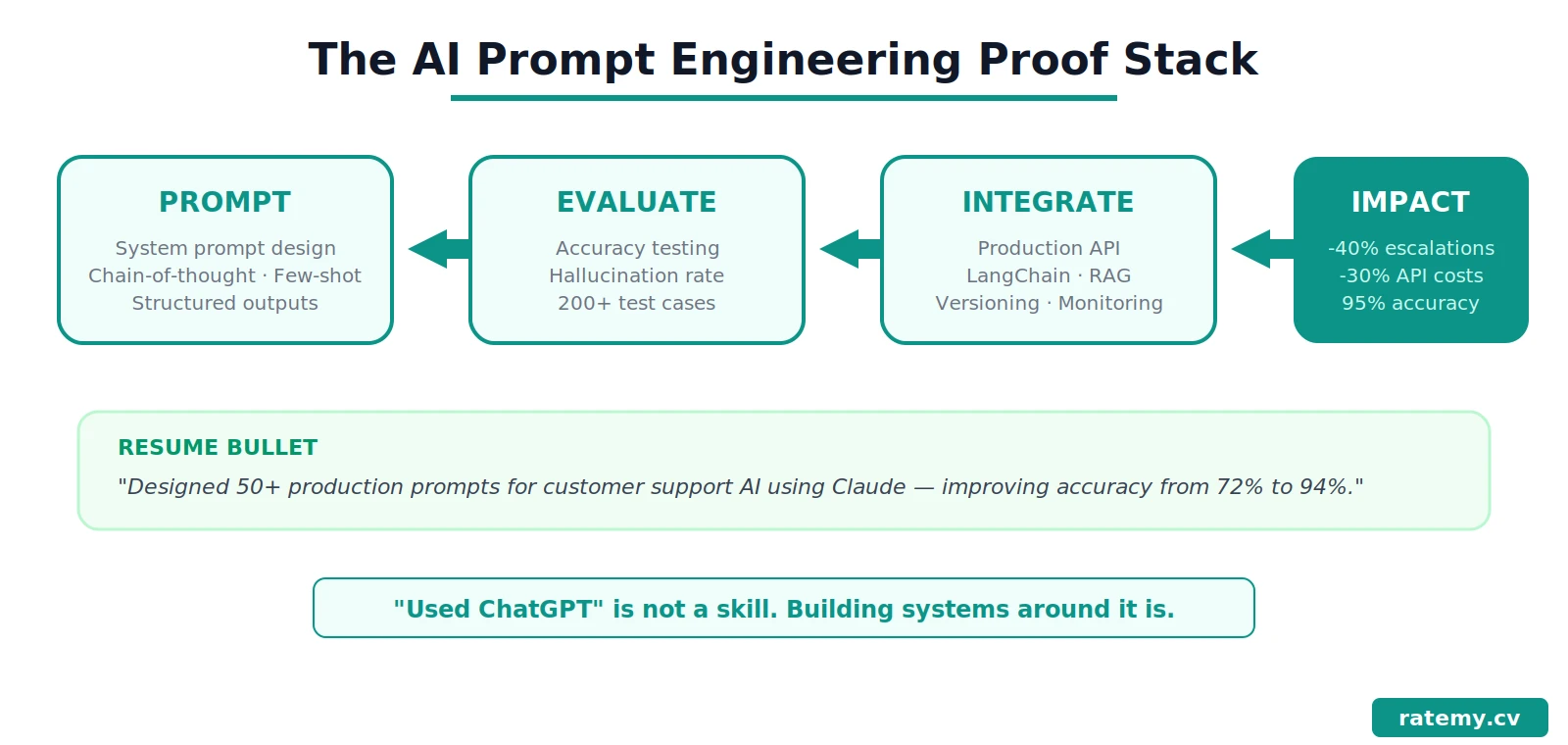
Resume example: Designed and optimized 50+ production prompts for a customer support AI using Claude, implementing chain-of-thought reasoning and few-shot examples that improved response accuracy from 72% to 94% while reducing average token usage by 35%.
AI Model Evaluation and Testing
Prompt engineering is not just writing — it is measuring. Hiring managers look for candidates who can systematically evaluate prompt performance using metrics like accuracy, consistency, latency, hallucination rate, and user satisfaction. This is what separates someone who "plays with ChatGPT" from a professional prompt engineer.
On your resume, describe your evaluation methodology: how you tested prompts, what metrics you tracked, how you identified failure modes, and what improvements resulted from your testing. If you used automated evaluation frameworks or built custom testing pipelines, mention them.
Resume example: Built automated prompt evaluation pipeline using Python that tested 200+ prompt variations across 5 use cases, measuring accuracy, hallucination rate, and output consistency — identifying the optimal prompt structure that reduced error rate from 18% to 3.2%.
Large Language Model Integration
Production prompt engineering requires integrating LLMs into real applications — not just testing prompts in a chat interface. Experience with AI frameworks and APIs is a strong signal on a prompt engineer resume. Key technologies include the OpenAI API, Anthropic API (Claude), LangChain, LlamaIndex, vector databases (Pinecone, Weaviate, Chroma), and retrieval-augmented generation (RAG) architectures.
If you have built AI-powered features that shipped to real users, this is some of the strongest experience you can put on a prompt engineering resume.
Resume example: Built RAG-based document Q&A system using LangChain, Pinecone, and GPT-4 that processed 10,000+ internal documents for a legal services company — reducing research time by 60% and handling 500+ daily queries with 91% user satisfaction.
Natural Language Processing Fundamentals
While prompt engineering does not always require deep NLP expertise, understanding the fundamentals — tokenization, embeddings, context windows, temperature and sampling parameters, fine-tuning concepts, and model architectures — makes you a stronger prompt engineer and a more attractive candidate.
Candidates with computer science backgrounds or machine learning experience should highlight NLP knowledge on their resume. Even basic understanding of how language models process text helps you write better prompts and debug unexpected outputs.
Resume example: Optimized prompt token efficiency across 12 production use cases by restructuring system prompts and implementing dynamic context window management, reducing API costs by $4,200/month while maintaining output quality above 95% accuracy threshold.
Python and AI Development Tools
Python is the default programming language for AI development. Most prompt engineering roles require at least basic Python proficiency for API integration, data processing, prompt testing automation, and building evaluation pipelines. If you write Python, list it alongside your prompt engineering skills.
Related tools worth listing include Jupyter notebooks, Git and GitHub for prompt versioning, data analysis libraries (pandas, NumPy), and AI-specific frameworks like LangChain, Semantic Kernel, and Hugging Face.
Reality check: Prompt engineering is evolving fast. The frameworks and AI platforms that matter today may be different in twelve months. What does not change is the underlying skill: understanding how to communicate effectively with AI systems and measure the results. That is what belongs on your resume — not just the tool names.
Domain Expertise and AI Applications
The most valuable prompt engineers combine AI skills with deep knowledge of a specific domain — healthcare, legal, finance, education, customer support, marketing, or software engineering. Domain expertise means you can evaluate whether AI outputs are actually correct, not just fluent.
On your resume, connect your prompt engineering work to the business domain. A prompt that generates marketing copy requires different evaluation criteria than one that summarizes legal contracts. Hiring managers notice candidates who understand the domain their AI serves.
Resume example: Developed medical triage prompt system for a telehealth platform using GPT-4 with safety guardrails and structured output validation, achieving 97% accuracy on standardized clinical scenarios while maintaining full regulatory compliance.
How to Write Prompt Engineering Resume Bullets
Use the Problem → Action → Result Framework
Every effective prompt engineering resume bullet follows this structure: what was the AI challenge, what prompt strategy did you implement, and what was the measurable result?
Weak: Wrote prompts for AI chatbot using ChatGPT.
Strong: Redesigned customer-facing chatbot prompt architecture from single-turn to multi-step chain-of-thought prompting, reducing escalation to human agents by 40% and improving customer satisfaction scores from 3.2 to 4.6 out of 5.
The weak version tells hiring managers you have used ChatGPT. The strong version tells them you engineered a system that produced business results. That is the difference between listing a tool and demonstrating a skill.
Quantify Your AI Impact
Prompt engineering work produces measurable outcomes — your resume should capture them. Metrics that work well include: accuracy improvements, hallucination rate reductions, response time improvements, API cost savings, user satisfaction scores, automation rates (human tasks replaced), output consistency percentages, and business metrics influenced (revenue, cost savings, time saved).
Entry-level prompt engineer: Designed and tested 30+ prompt templates for content generation across blog posts, product descriptions, and email campaigns — achieving 85% first-draft acceptance rate and reducing content production time by 50% for a 5-person marketing team.
Experienced prompt engineer: Architected prompt versioning system using Git and automated evaluation pipeline, managing 100+ production prompts across 8 AI features — maintaining 95%+ accuracy while shipping 15 prompt updates per sprint without production regressions.
Senior AI prompt engineer: Led prompt engineering strategy for enterprise AI platform serving 50K+ daily users, designing evaluation frameworks, establishing prompt governance policies, and mentoring 4 junior engineers — reducing model-related support tickets by 70% in 6 months.
Should You Put ChatGPT Experience on Your Resume?
Yes — but with context. "Experienced with ChatGPT" is meaningless in 2026 because nearly everyone uses it. What matters is what you built with it. If you used ChatGPT (or Claude, Gemini, or any other model) to build a product feature, automate a workflow, or solve a business problem, describe the project, the prompt techniques you used, and the outcome. That is resume-worthy. Casual usage is not.
Where to Put Prompt Engineering Skills on Your Resume
Skills Section
Group your prompt engineering and AI skills into clear categories:
AI & Prompt Engineering: Prompt Design, Prompt Optimization, Chain-of-Thought Prompting, Few-Shot Learning, RAG Architecture, Prompt Versioning, AI Evaluation
AI Models & Platforms: GPT-4, Claude (Anthropic), Gemini, Llama, Mistral, OpenAI API, Anthropic API
AI Frameworks: LangChain, LlamaIndex, Semantic Kernel, Pinecone, Weaviate, Hugging Face
Languages & Tools: Python, Jupyter, Git/GitHub, pandas, SQL, REST APIs
Domain Skills: [List your specific domain expertise — marketing, legal, healthcare, engineering, etc.]
Prompt Engineering Resume Summary
Your resume summary should immediately establish what kind of prompt engineering work you do and the impact you deliver.
Entry-level prompt engineering resume summary: AI-focused professional with hands-on experience designing and testing prompts for GPT-4 and Claude across content generation, data extraction, and customer support applications. Built 3 AI-powered tools using LangChain and Python, including a document summarization system processing 500+ pages daily.
Experienced prompt engineer resume summary: Prompt engineer with 3+ years of experience designing production AI systems using GPT-4, Claude, and open-source models. Proven track record of improving model accuracy by 20%+, reducing API costs by 30%+, and building AI features serving 10K+ daily users. Proficient in Python, LangChain, RAG architectures, and automated prompt evaluation.
Certifications and Education
Prompt engineering is new enough that formal certifications are still emerging. The most recognized credentials include the Vanderbilt University Prompt Engineering Specialization (Coursera), DeepLearning.AI courses, and platform-specific certifications from cloud providers. A computer science degree or machine learning coursework strengthens a prompt engineering resume but is not strictly required — many successful prompt engineers come from linguistics, writing, or domain-expert backgrounds.
If you have relevant AI projects on GitHub, include a link in your resume header. A portfolio of documented prompt engineering projects is more convincing than any certification alone.
Prompt Engineer Resume Examples by Experience Level
Entry-Level Prompt Engineering Resume
If you are new to prompt engineering, focus on personal AI projects, open-source contributions, coursework, and any professional work where you applied AI tools to solve real problems. Even using ChatGPT or Claude to automate part of your current job counts — if you can describe the prompt strategy, testing process, and business outcome.
What to emphasize: AI projects (with GitHub links), prompt design methodology, Python basics, API integration experience, relevant coursework or certifications, domain knowledge.
Experienced Prompt Engineer Resume
Mid-level prompt engineers should demonstrate production experience — prompts that are live, serving real users, and being maintained over time. Your resume should show that you understand not just how to write a good prompt, but how to build reliable AI systems that scale.
What to emphasize: Production AI features shipped, model performance metrics, prompt versioning and governance, cross-functional collaboration with engineering teams, evaluation frameworks, API cost optimization.
Senior Prompt Engineer Resume
Senior prompt engineers and AI leads need a resume that shows strategic thinking — prompt architecture decisions, team mentoring, AI governance, and organizational AI adoption. At this level, you are not just writing prompts; you are defining how your organization uses AI.
What to emphasize: AI strategy and roadmap, team leadership, prompt governance frameworks, enterprise-scale AI systems, model evaluation methodology, stakeholder communication, cost and risk management.
Common Mistakes on a Prompt Engineering Resume
Listing "ChatGPT" as a Skill Without Context
This is the single most common mistake. In 2026, listing ChatGPT without describing what you built with it is like listing "Google" as a skill. Specify the models you used, the prompt techniques you applied, and the outcomes you achieved.
Overemphasizing Tools Over Methodology
Prompt engineering tools and AI platforms change rapidly. A resume that lists 15 AI tools but describes no methodology — evaluation, testing, optimization, versioning — looks like someone who follows trends rather than someone who engineers solutions.
No Measurable Outcomes
"Improved AI responses" is not a resume bullet — it is a claim without evidence. Every prompt engineering bullet needs a metric: accuracy percentage, cost reduction, time saved, user satisfaction score, or business impact.
Ignoring the Domain
A prompt engineer who works on healthcare AI needs different evaluation criteria than one working on marketing content. If your resume does not mention the domain you work in, hiring managers cannot assess whether your experience is relevant to their use case.
How to Format a Prompt Engineering Resume (ATS-Friendly Tips)
Use a clean, single-column layout with standard section headers. Write "Prompt Engineering" as a clear, standalone term in your skills section — applicant tracking systems search for this exact phrase. Also include "AI," "LLM," "GPT-4," "Claude," and "NLP" as separate terms since job descriptions use all of these.
Save your resume as PDF or DOCX. Include links to GitHub projects or AI portfolios in your resume header. Avoid graphics, skill bars, and percentage ratings — they break ATS parsing and add no information.
Prompt Engineering Resume FAQs
Should I put prompt engineering on my resume? Yes — if you have done more than casual ChatGPT usage. Prompt engineering belongs on your resume if you have designed prompts for a specific purpose, tested and optimized them, integrated AI into a workflow or product, or built AI-powered tools. Casual usage of AI chatbots does not qualify as prompt engineering.
What do employers look for in a prompt engineering resume? Employers look for demonstrated experience with specific AI models (GPT-4, Claude, Gemini), prompt design methodology (few-shot, chain-of-thought, RAG), measurable outcomes (accuracy, cost savings, user satisfaction), and integration experience (APIs, LangChain, Python). Domain expertise relevant to the company's use case is a strong differentiator.
Is a degree necessary to become a prompt engineer? No. While a computer science or NLP background helps, many prompt engineers come from non-technical fields — writing, linguistics, marketing, domain expertise. What matters is demonstrated ability to design effective prompts, evaluate outputs, and improve AI system performance. A strong portfolio of AI projects can substitute for formal credentials.
What is prompt engineering? Prompt engineering is the practice of designing, testing, and optimizing the instructions given to large language models to produce accurate, consistent, and useful outputs. It combines technical understanding of how AI models work with communication skills, domain expertise, and systematic evaluation methodology.
How can I create a prompt engineering resume with no experience? Build AI projects. Use GPT-4 or Claude to solve a real problem — automate a workflow, build a chatbot, create a content generation pipeline. Document your prompt strategy, testing process, and results. Publish the project on GitHub. Complete a prompt engineering course (Vanderbilt or DeepLearning.AI). That portfolio is your resume experience.
Check Your Prompt Engineering Resume Now
Not sure if your resume showcases your AI skills effectively — or if the ATS can even parse "prompt engineering" from your experience section? Upload your resume and a target job description to see exactly which AI keywords you are missing.
Run your resume through RateMy.CV → — see exactly what ATS systems and hiring managers see, with specific feedback on missing prompt engineering keywords and weak bullets.
The scan takes 30 seconds. Because if you can engineer prompts that get results from AI, you should be able to engineer a resume that gets results from hiring managers too.
Related Resume Skills Guides
🎯 How does your resume score?
Upload your resume and a job description — our free scanner shows your match score, missing keywords, and what to fix. Takes 30 seconds.
Run Your Resume Through RateMy.CV — Free