
Time Management Skills Resume: How to Prove It
"Excellent time management skills." That phrase appears on millions of resumes, and it convinces approximately zero hiring managers. Not because time management is unimportant — it is one of the most universally valued skills in the workplace — but because the phrase alone is empty. It tells a recruiter nothing about how you actually manage your time, what results your organizational skills produce, or whether you can handle the pace and complexity of the role they are hiring for.
The challenge with time management on a resume is the same challenge you face with any soft skill: you cannot just list it. You have to demonstrate it. And demonstrating time management means showing that you consistently meet deadlines, juggle competing priorities, deliver results under pressure, and do all of this without someone standing over your shoulder telling you what to do next.
This guide covers how to describe time management skills on your resume with specific examples, which time management abilities employers actually care about, how to write resume bullets that prove effective time management, and the mistakes that make time management claims feel generic.
What Are Time Management Skills?
Time management skills are the abilities that help you use your time effectively and productively — planning your work, prioritizing tasks, meeting deadlines, and managing competing demands without dropping the ball. People call time management a "soft skill," but the outcomes are very concrete — projects delivered on time, goals met, productivity maintained, and stress managed.
Time management is not a single ability. It is a collection of related skills that work together. The most important ones for a resume include prioritization, planning and scheduling, deadline management, delegation, focus and concentration, goal setting, and the ability to say no to low-value work. Each of these can be demonstrated with specific examples on your resume — and each carries more weight than the generic label "time management."
Why Are Time Management Skills Important on a Resume?
Every workplace has too much work and not enough time. Employers hire people who can figure out what matters most, do it well, and do it on time — without constant supervision. That is what time management really means in the workplace, and that is why it appears in job descriptions across every industry.
Hiring managers look for time management skills because poor time management creates visible problems: missed deadlines, rushed deliverables, dropped tasks, and teammates who have to pick up the slack. Strong time management, by contrast, is often invisible — things just get done. Your resume is the place to make that invisible skill visible.
The key insight: time management on a resume is not about telling employers you manage time well. It is about showing them the outcomes that only happen when someone manages their time effectively.
The Best Time Management Skills for Your Resume
Prioritization
Prioritization is the most valuable time management skill — and the one most worth highlighting on your resume. It means knowing which tasks matter most and focusing your energy there, even when less important work is competing for your attention.
On your resume, describe situations where you had competing priorities and made deliberate choices about where to focus. The outcome should demonstrate that your prioritization led to better results than doing everything would have.
Resume example: Managed a backlog of 40+ feature requests by implementing a weighted scoring framework based on customer impact and engineering effort, ensuring the 3 highest-value features shipped each sprint — on time, every quarter for 18 months.
Deadline Management
Meeting deadlines consistently is one of the most concrete ways to demonstrate time management on a resume. But "met all deadlines" is generic. Effective deadline management bullets describe the scope, the constraint, and the result.
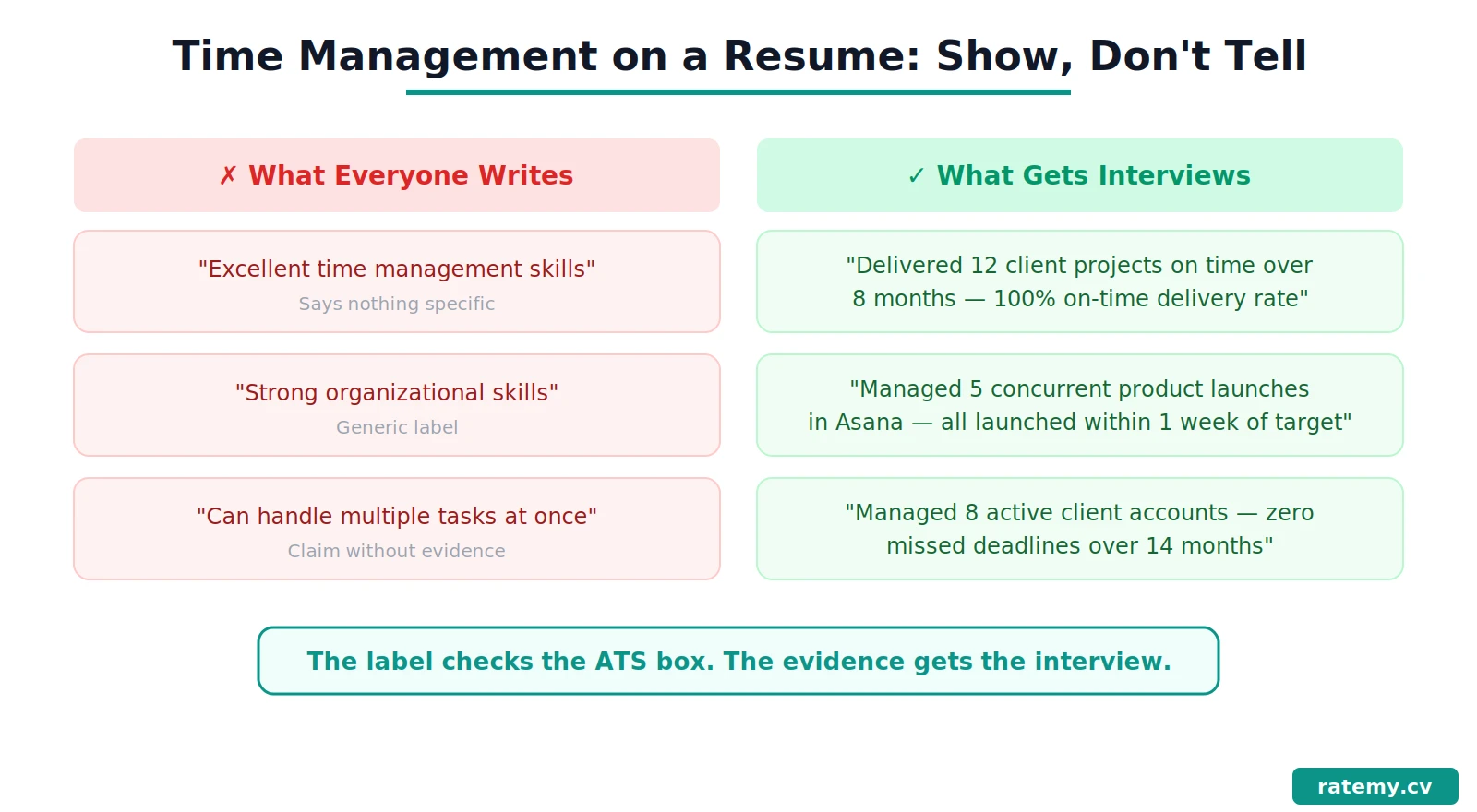
Resume example: Delivered 12 client projects within deadline over 8 months, including 3 that required timeline compression due to scope changes — maintaining 100% on-time delivery rate and a 4.8/5.0 client satisfaction score.
Project Planning and Scheduling
Planning skills show that you do not just react to work — you organize it proactively. If you have created project plans, built schedules, managed timelines in project management software, or coordinated work across teams, describe the scale and the outcome.
Resume example: Created and maintained project schedules for 5 concurrent product launches using Asana, coordinating deliverables across design, engineering, and marketing teams — all 5 launched within 1 week of target date.
Delegation
Delegation is a time management skill that many candidates forget to include on their resume. Knowing what to hand off — and trusting others to execute — is essential for anyone in a management or leadership role. It shows that you understand you cannot do everything yourself, and that you manage your time by empowering others.
Resume example: Delegated routine reporting tasks to 2 junior analysts by creating standardized templates and SOPs, freeing 10 hours per week for strategic analysis that directly informed the Q3 pricing decision.
Multitasking and Task Switching
Multitasking gets a bad reputation in productivity circles, but many jobs genuinely require managing multiple workstreams simultaneously. If you have successfully handled multiple projects, clients, or responsibilities at the same time, that is worth describing on your resume — with evidence that quality did not suffer.
Resume example: Managed 8 active client accounts simultaneously across different industries, maintaining personalized communication cadences and delivering monthly performance reports on schedule for every account — zero missed deadlines over 14 months.
Time Blocking and Focus
For roles that require deep work — writing, coding, analysis, design — the ability to protect focused time is a genuine time management skill. If you have implemented time management techniques that improved your output quality or productivity, describe the result.
Resume example: Implemented time blocking system for the content team, dedicating morning hours to writing and afternoon hours to editing and meetings — increasing published articles from 8 to 14 per month without adding headcount.
Reality check: Listing "time management" in your skills section checks the ATS box. But hiring managers have read that phrase a thousand times. The only thing that makes it real is evidence in your experience bullets — deadlines met, projects delivered, productivity improved, chaos managed. Show the outcomes, not the label.
How to Describe Time Management on Your Resume
Replace the Label with Proof
The single most effective thing you can do: stop writing "strong time management skills" and start writing bullets that prove it. Every time management claim on your resume should be backed by a specific example with a measurable outcome.
Weak: Excellent time management and organizational skills.
Strong: Coordinated the simultaneous rollout of 3 product updates across 4 regional teams, building a shared timeline in Monday.com that kept all workstreams aligned — completing the rollout 2 days ahead of the executive deadline.
Use Time-Focused Action Verbs
The verbs you use signal whether you manage time or just fill it. Strong time management verbs include:
Planning verbs: Scheduled, Planned, Coordinated, Organized, Structured, Mapped, Forecasted, Sequenced
Execution verbs: Delivered, Completed, Launched, Shipped, Executed, Accelerated, Streamlined, Expedited
Efficiency verbs: Reduced, Saved, Optimized, Consolidated, Automated, Eliminated, Simplified
Avoid passive phrases like "was responsible for meeting deadlines" — that describes the expectation, not your skill.
Quantify Time and Efficiency
Time management is inherently measurable — use numbers to make it concrete. Metrics that work well include: deadlines met, delivery timelines, time saved, productivity improvements, number of concurrent projects, response times, and cycle time reductions.
Operations: Reduced order processing time from 48 hours to 18 hours by redesigning the fulfillment workflow, saving the team 15 hours per week and improving customer delivery SLA compliance from 82% to 97%.
Sales: Maintained a pipeline of 60+ active prospects while meeting all weekly activity targets — 50 calls, 25 emails, 5 demos — consistently finishing in the top 10% of the team for both activity volume and closed revenue.
Customer service: Handled average of 65 support tickets per day while maintaining a 12-minute average response time and 96% customer satisfaction rating — ranked #1 in team productivity for 3 consecutive quarters.
Management: Managed a team of 8 across 3 time zones, implementing async standup updates and shared priority boards that reduced meeting time by 5 hours per week while improving sprint completion rate from 72% to 94%.
Marketing: Planned and executed a 90-day product launch campaign with 45 individual deliverables across content, email, paid media, and PR — delivering every asset on schedule despite a 2-week timeline compression from leadership.
Where to Include Time Management Skills on Your Resume
Skills Section
Include "Time Management" in your skills section for ATS matching. Group it with related organizational skills rather than listing it alone:
Organizational & Management: Time Management, Project Planning, Prioritization, Deadline Management, Cross-Functional Coordination, Agile/Scrum
This is more credible than "Time Management" sitting next to "Microsoft Word."
Resume Summary
Your resume summary is a strong place to signal effective time management — but only with evidence attached.
Weak: Detail-oriented professional with strong time management skills.
Strong: Operations coordinator with 4+ years of experience managing complex timelines across sales, logistics, and customer success teams. Track record of delivering 50+ projects on time and reducing process cycle times by 30%+ through workflow redesign and prioritization frameworks.
Experience Bullets (Where It Matters Most)
This is where time management skills actually live on your resume. Every role should include at least one bullet that demonstrates you managed time, deadlines, or competing priorities effectively — and that the outcome was measurable.
Good Time Management Skills in the Workplace
Employers look for time management skills that translate directly into workplace productivity. Here are the specific abilities that show good time management in practice:
Meeting deadlines consistently — not occasionally, not "usually," but as a pattern. If you have a track record of on-time delivery, quantify it.
Managing competing priorities — showing that you can handle multiple workstreams without dropping quality on any of them.
Working independently — time management is really about self-management. Employers value people who do not need constant direction.
Adapting to changing timelines — scope changes, urgent requests, shifted priorities. Effective time management includes flexibility, not just rigid scheduling.
Improving team efficiency — if your time management skills benefited others (streamlining processes, creating systems, reducing meetings), that is a strong resume point.
Common Time Management Resume Mistakes
Just Writing "Excellent Time Management Skills"
This is the most common mistake. The phrase is so overused it has become invisible. Replace it with specific evidence in your experience bullets.
Listing Time Management Without Proof
If "Time Management" appears in your skills section but nowhere in your experience bullets, it looks like padding. Every soft skill in your skills section needs at least one supporting bullet in your work experience.
Being Too Vague About Deadlines
"Met all project deadlines" sounds good but lacks context. How many projects? Over what timeframe? Under what constraints? Specificity makes the claim credible.
Confusing Busyness with Time Management
Some resumes describe being overwhelmed — "managed heavy workload" or "handled high-volume tasks" — without showing that the outcomes were strong. Being busy is not the same as managing time well. Focus on what you delivered, not how much you had on your plate.
Ignoring Time Management for Non-Management Roles
Time management is not just for managers and project leaders. Customer service representatives who handle high ticket volumes, sales professionals who manage pipelines, individual contributors who juggle multiple projects — all of these roles require demonstrable time management skills.
How to Improve Your Time Management Skills
If you want stronger time management examples for your resume, start tracking your productivity wins now. Document deadlines met, process improvements implemented, and efficiency gains achieved. Use tools like Asana, Trello, Monday.com, or even a simple spreadsheet to track what you deliver and when.
Time management techniques worth learning — and worth mentioning on your resume if you have used them effectively — include time blocking, the Eisenhower matrix for prioritization, the Pomodoro technique for focus, and agile sprint planning for team-based work.
Time Management Skills Resume FAQs
How do you describe time management on a resume? Do not just write "time management." Instead, describe specific situations where you met deadlines, managed competing priorities, or improved efficiency — and include measurable results. Use action verbs like "delivered," "coordinated," "streamlined," and "prioritized" to show time management in action.
Should I list time management as a skill or show it in my experience? Both. List "Time Management" in your skills section for ATS matching, and demonstrate it through your experience bullets with specific examples and quantified outcomes. The skills section gets you past the filter; the experience section convinces the hiring manager.
What are the 5 most important time management skills? Prioritization, deadline management, planning and scheduling, delegation, and the ability to work independently without constant supervision. These five cover the core of what employers mean when they say they want "good time management skills."
How can I quantify time management skills on my resume? Use metrics: number of deadlines met, projects delivered on time, hours saved per week, process cycle time reductions, concurrent projects managed, response times maintained, and productivity improvements achieved. Any number that shows you delivered results efficiently demonstrates time management.
What if I do not have direct time management experience? Every job involves managing time — even entry-level roles. Describe how you handled competing assignments in school, balanced a part-time job with coursework, managed multiple customer requests simultaneously, or organized events with fixed deadlines. Frame it with the problem-action-result structure and it becomes a credible resume bullet.
Check Your Time Management Resume Now
Not sure if your resume proves your time management skills — or just lists them alongside every other soft skill? Upload your resume and a target job description to see exactly where your bullets need stronger evidence.
Run your resume through RateMy.CV → — see exactly what ATS systems and hiring managers see, with specific feedback on vague bullets and missing keywords.
The scan takes 30 seconds. Because good time management starts with knowing where you actually stand.
Related Resume Skills Guides
🎯 How does your resume score?
Upload your resume and a job description — our free scanner shows your match score, missing keywords, and what to fix. Takes 30 seconds.
Run Your Resume Through RateMy.CV — Free