
Adaptability Skills Resume: Show You Thrive in Change
The job market in 2026 rewards people who can handle whatever comes next. New tools, new processes, restructured teams, shifting priorities, entire business models changing overnight — employers have learned the hard way that the most technically skilled person in the room is not always the most valuable. The most valuable person is often the one who can adjust, learn fast, and keep delivering when the ground shifts under them.
That is what adaptability means in the workplace. And it is one of the most sought-after soft skills on a resume right now. But here is the problem: "adaptability" on a resume, by itself, is vague. It sounds like filler. It sits in a skills section next to "team player" and "self-motivated" and blends into the background noise that hiring managers have trained themselves to ignore.
This guide covers what adaptability skills actually are, why employers value them so highly, how to showcase adaptability on your resume with specific examples that prove you handle change well, and the types of adaptability that matter most in 2026.
What Are Adaptability Skills?
Adaptability skills are the abilities that help you adjust to new situations, learn new skills quickly, handle unexpected challenges, and remain productive when circumstances change. People call adaptability a "soft skill," but it shows up in very concrete ways: taking on a new role when someone leaves, learning new software in a week instead of a month, pivoting a project when the strategy changes, or staying effective when your team shifts from in-office to remote.
Adaptability is not a single ability. It is a collection of related skills that include flexibility, resilience, openness to feedback, willingness to learn, creative problem-solving, emotional adaptability, and the ability to work effectively across different environments, tools, teams, and cultures. Each of these can be demonstrated on your resume with specific examples — and each is more convincing than the word "adaptable" sitting in a bullet list.
Why Do Employers Value Adaptability Skills?
Five years ago, most teams could ignore change for months. In 2026, workflows can shift in a week. AI tools are reshaping workflows. Companies restructure more frequently. Remote and hybrid work environments require different communication skills. New software and systems get adopted constantly. Employers who have been through these transitions know that the employees who thrive are not the ones who resist change — they are the ones who absorb it, adjust, and keep moving forward.
Adaptability matters especially in startups, technology companies, healthcare, and any industry where the pace of change is high. But even in stable industries, hiring managers look for adaptability because every role eventually faces unexpected challenges. The question on every recruiter's mind when reading your resume is: "If something changes — and it will — will this person handle it, or will they freeze?"
Your resume needs to answer that question with evidence, not just the word "adaptable."
Types of Adaptability Skills for Your Resume
Learning Agility
Learning agility — the ability to pick up new skills, tools, and knowledge quickly — is the adaptability skill employers value most in 2026. With new software, AI tools, and processes emerging constantly, hiring managers need people who can learn fast without extensive hand-holding.
On your resume, describe situations where you learned something new and applied it effectively in a short timeframe. The speed of your learning and the outcome it produced are what make this skill tangible.
Resume example: Self-taught Salesforce administration in 3 weeks to cover for a departing team member, maintaining CRM operations for a 40-person sales team and completing the Salesforce Admin certification within 2 months.
Flexibility in Changing Environments
Flexibility means adjusting your approach when circumstances change — shifting priorities, evolving strategies, new team structures, or unexpected obstacles. It is different from learning agility in that it is about mindset and behavior, not just knowledge acquisition.
Resume example: Adapted marketing strategy mid-campaign when a product launch was delayed by 6 weeks, pivoting from launch-focused content to brand-awareness content that maintained audience engagement and generated 2,400 email signups during the delay.
Resilience Under Pressure
Resilience is the adaptability skill that shows you can maintain productivity and quality when things go wrong — tight deadlines, budget cuts, team departures, client emergencies, or organizational restructuring. Employers value resilience because every organization faces pressure, and they need people who perform through it rather than crumbling.
Resume example: Maintained project delivery during a 30% team reduction by restructuring workflows, reprioritizing the feature backlog, and personally absorbing QA responsibilities — shipping 4 of 5 planned features on the original timeline.
Emotional Adaptability
Emotional adaptability is the ability to stay composed, constructive, and collaborative during stressful or uncertain situations. It shows up in how you handle feedback, navigate conflict, support teammates through change, and manage your own stress. This is especially important for leadership and management roles.
Resume example: Facilitated team transition to a new project management tool despite initial resistance from senior team members, running 4 training sessions and one-on-one coaching that achieved full team adoption within 3 weeks.
Cross-Functional and Cultural Adaptability
Working effectively across different teams, departments, and cultures demonstrates a breadth of adaptability that many resumes overlook. If you have worked across functions (engineering + marketing, sales + product) or across geographies and cultures, describe how you adapted your communication style and approach.
Resume example: Collaborated with engineering, design, and customer success teams across 3 time zones during product redesign, adapting communication style and meeting cadence to accommodate async workflows — delivering the project 1 week ahead of schedule.
Technological Adaptability
In 2026, the ability to adopt new technology quickly is one of the most practical forms of adaptability. Whether it is learning a new software tool, adapting to AI-powered workflows, or migrating to a new platform, technological adaptability shows that you will not become a bottleneck when the organization evolves its tech stack.
Resume example: Led team adoption of AI-assisted content workflow using ChatGPT and Jasper, creating prompt templates and editorial guidelines that reduced first-draft production time by 45% while maintaining brand voice consistency.
Reality check: Employers do not care that you are "open to change." They care that the last time something changed — a tool, a team, a strategy, a deadline — you handled it and the outcomes were good. That is what belongs on your resume.
How to Showcase Adaptability on Your Resume
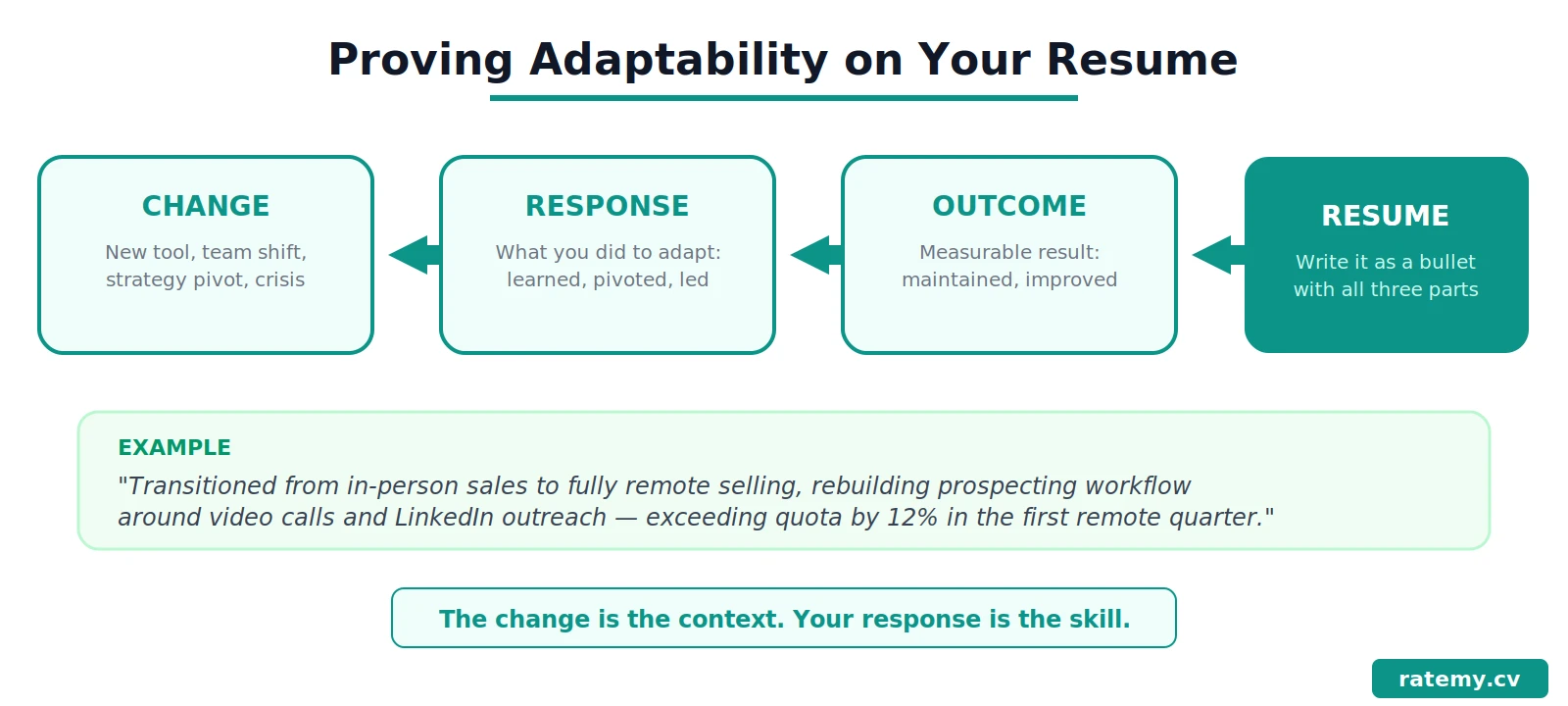
Replace the Label with Evidence
The most important rule: do not list "adaptable" or "adaptability" as a standalone skill and assume it carries weight. It does not. The word becomes meaningful only when your experience bullets prove it.
Weak: Highly adaptable professional with strong flexibility skills.
Strong: Transitioned from in-person sales to fully remote selling during 2020, rebuilding prospecting workflow around video calls and LinkedIn outreach — exceeding quota by 12% in the first remote quarter while onboarding 3 new team members virtually.
Use Adaptability Action Verbs
The verbs you choose signal whether you adapt or resist. Strong adaptability verbs include:
Change verbs: Adapted, Pivoted, Transitioned, Evolved, Shifted, Adjusted, Restructured, Transformed
Learning verbs: Learned, Mastered, Adopted, Acquired, Self-taught, Upskilled, Cross-trained
Resilience verbs: Maintained, Sustained, Preserved, Navigated, Overcame, Managed, Recovered
Avoid passive language like "was asked to take on new responsibilities." Instead: "Took on product management responsibilities during leadership transition, maintaining sprint velocity while learning the PM workflow."
Show the Before and After
The strongest adaptability bullets show contrast — what the situation was before, what changed, and how you adapted to produce a positive outcome. This before-and-after structure makes adaptability tangible.
Customer service: Adapted from phone-only support to omnichannel support (phone, chat, email, social) within 2 weeks of platform rollout, maintaining a 95% CSAT score and handling 30% higher ticket volume through the new channels.
Engineering: Pivoted mid-sprint when a critical API partner deprecated their v2 endpoint, researching alternatives, implementing a new integration with a competitor API, and shipping the feature with only a 3-day delay.
Management: Restructured team workflows after losing 2 senior engineers, redistributing ownership across 4 remaining team members and implementing pair programming that maintained code review quality and sprint completion rate above 90%.
Marketing: Adjusted annual content strategy after Google algorithm update reduced organic traffic by 35%, shifting focus to video content and community-driven distribution that recovered traffic within 4 months and diversified acquisition channels.
Healthcare: Transitioned from in-person patient intake to telehealth model in under 2 weeks, training 12 front-desk staff on new scheduling and video platforms while maintaining patient appointment volume at 92% of pre-transition levels.
Where to Include Adaptability Skills on Your Resume
Skills Section
Include "Adaptability" and related terms in your skills section for ATS matching. Group them with complementary soft skills:
Core Skills: Adaptability, Flexibility, Cross-Functional Collaboration, Change Management, Resilience, Continuous Learning
This is more credible than "Adaptability" sitting alone next to technical tool names.
Resume Summary
Signal adaptability in your summary — but only with evidence attached.
Weak: Adaptable professional seeking new opportunities.
Strong: Marketing manager with 5+ years of experience across agency and in-house environments, known for adapting strategies quickly when markets shift. Pivoted 3 major campaigns mid-flight due to product or market changes, delivering positive ROI on all three.
Experience Bullets
This is where adaptability actually lives on your resume. Every role should include at least one bullet showing how you adapted to change — a new tool, a new team structure, a new strategy, an unexpected challenge — and delivered results despite the disruption.
How to Improve Your Adaptability Skills
If you want stronger adaptability examples on your resume, start seeking out change rather than waiting for it to find you. Volunteer for cross-functional projects. Learn a new tool before you are forced to. Take on responsibilities outside your comfort zone. Ask for feedback and act on it visibly.
Document these moments as they happen — what changed, how you adapted, and what the outcome was. These become your resume bullets later.
Adaptability is also built through exposure to different work environments, cultures, industries, and methodologies. The more variety you experience, the more naturally you adapt when circumstances shift.
Common Mistakes When Listing Adaptability on a Resume
Just Writing "Adaptable" or "Flexible"
These words alone are meaningless on a resume. They need supporting evidence in your experience bullets to carry any weight.
Describing Change Without Showing Your Response
Some resumes describe organizational changes — "company underwent restructuring" — without explaining how the candidate adapted. The change is the context; your response is the skill. Focus on what you did, not what happened to you.
Confusing Compliance with Adaptability
Following instructions when your manager tells you to use a new tool is not adaptability — it is basic compliance. Real adaptability involves initiative: learning proactively, suggesting improvements during transitions, helping teammates adapt, and maintaining or improving performance through the change.
Overlooking Adaptability for Technical Roles
Technical professionals sometimes assume adaptability is only relevant for management or client-facing roles. It is not. Engineers who learn new frameworks quickly, data analysts who pivot when data sources change, and developers who adapt to new team structures all demonstrate adaptability. Include it.
Adaptability Skills Resume FAQs
How do you say adaptability on a resume? Do not just write "adaptable." Instead, describe a specific situation where something changed and you adapted — a new tool, a team restructuring, a shifted strategy — and include the measurable outcome. Use verbs like "adapted," "pivoted," "transitioned," and "learned" to show adaptability in action.
Is adaptability a good skill for a resume? Yes — adaptability is one of the most valued soft skills across all industries. Employers consistently rank it among their top hiring criteria. The key is demonstrating it through specific examples rather than listing it as a generic label.
How do I professionally say I am adaptable? Use phrases that describe what you actually did: "Transitioned to remote workflow and maintained full productivity," "Learned new CRM system in 2 weeks and trained 5 team members," "Pivoted campaign strategy based on market shift and delivered 15% above target." These prove adaptability far more effectively than stating "I am adaptable."
Is adaptability a skill or a quality? Both. Adaptability is a soft skill that can be developed and improved — but it also reflects personal qualities like resilience, openness, and curiosity. On a resume, treat it as a demonstrable skill by providing evidence of times you adapted successfully and the outcomes that resulted.
What are some common adaptability skills? The most common adaptability skills include learning agility, flexibility, resilience, emotional adaptability, openness to feedback, creative problem-solving, cross-cultural communication, and technological adaptability. The strongest resumes demonstrate these through specific workplace examples rather than listing them as labels.
Check Your Adaptability Resume Now
Not sure if your resume proves your adaptability — or just claims it? Upload your resume and a target job description to see exactly where your bullets need stronger evidence and which adaptability keywords are missing.
Run your resume through RateMy.CV → — see exactly what ATS systems and hiring managers see, with specific feedback on vague claims and missing keywords.
The scan takes 30 seconds. Because truly adaptable people do not just wait for feedback — they seek it out.
Related Resume Skills Guides
🎯 How does your resume score?
Upload your resume and a job description — our free scanner shows your match score, missing keywords, and what to fix. Takes 30 seconds.
Run Your Resume Through RateMy.CV — Free