
Google Analytics Resume: Skills That Get Hired
If a company tracks website behavior, chances are it touches Google Analytics. Marketing teams, product managers, e-commerce operators, and data analysts all rely on it to understand user behavior, measure campaign performance, and make data-driven decisions. That makes Google Analytics one of the most versatile skills you can list on a resume — it appears in job descriptions across marketing, analytics, product, and even sales roles.
But there is a problem. Because Google Analytics is so common, simply writing "Google Analytics" in your skills section does almost nothing to set you apart. Every digital marketing resume lists it. Every entry-level data analyst claims familiarity with it. The candidates who get interviews are the ones who demonstrate what they actually did with Google Analytics — which reports they built, what insights they uncovered, and which business decisions their analysis informed.
This guide covers exactly how to put Google Analytics on your resume, which analytics skills to highlight for different roles, how to write resume bullets that prove data-driven impact, and why Google Analytics 4 matters more than ever on a 2026 resume.
Why Does Google Analytics on Your Resume Matter So Much?
Google Analytics is not just a tool — it is a signal. When a hiring manager sees Google Analytics on your resume, they are evaluating whether you understand digital measurement, user behavior tracking, conversion rate optimization, and data reporting. For marketing data analyst roles, it is often a hard requirement. For broader data analyst or business data analyst positions, it demonstrates that you can work with real-world web data — not just cleaned datasets in a classroom.
The transition from Universal Analytics to Google Analytics 4 (GA4) has also created a skills gap. Many professionals still list "Google Analytics" on their resume without specifying whether they have GA4 experience. Organizations that have migrated to GA4 — which is now the default — want candidates who understand event-based tracking, custom dimensions, explorations, and BigQuery integration. Specifying GA4 on your resume immediately signals that your skills are current.
Top Google Analytics Skills to List on Your Resume in 2026
Google Analytics 4 (GA4) Core Proficiency
GA4 is fundamentally different from Universal Analytics. It uses an event-based data model instead of session-based tracking, which changes how you analyze user behavior, build reports, and set up conversions. Listing GA4 specifically — not just "Google Analytics" — tells recruiters you have worked with the current platform.
Key GA4 skills to highlight on your resume include: event tracking configuration, conversion setup, custom dimensions and metrics, audience building, exploration reports (funnel, path, segment overlap), data retention settings, and integration with Google Ads.
Resume example: Configured GA4 event tracking across a 200-page e-commerce site, defining 15 custom events and 8 conversion goals that gave the marketing team visibility into a checkout funnel processing $4.2M in annual revenue.
Data Reporting and Dashboard Building
Analytics professionals who can turn raw data into clear, actionable reports are far more valuable than those who simply pull numbers. On your resume, describe the dashboards and reports you built — what they tracked, who used them, and what decisions they informed.
Google Analytics integrates with Looker Studio (formerly Google Data Studio), and building automated dashboards that combine GA4 data with data from other sources is a highly marketable skill. If you have connected GA4 to Looker Studio, Google Sheets, or tools like Tableau, mention the integration and the stakeholders who relied on those reports.
Resume example: Built weekly Looker Studio dashboard pulling GA4, Google Ads, and CRM data for a 12-person marketing team — reducing manual reporting time by 8 hours per week and enabling real-time campaign optimization that improved ROAS by 34%.
Conversion Rate Optimization and Funnel Analysis
Understanding how users move through a website — and where they drop off — is one of the most commercially valuable analytics skills. Conversion rate optimization (CRO) combines Google Analytics data with user behavior analysis to identify and fix friction points in the customer journey.
On your resume, describe the funnels you analyzed, the drop-off points you identified, and the improvements your analysis produced. Marketing leaders and e-commerce directors care deeply about this skill because it directly impacts revenue.
Resume example: Analyzed GA4 funnel data to identify a 42% drop-off at the shipping options page, leading to a UX redesign that increased checkout completion rate by 18% and generated an estimated $320K in recovered annual revenue.
Audience Segmentation and User Behavior Analysis
GA4's audience builder allows analysts to create detailed user segments based on behavior, demographics, acquisition source, and engagement patterns. This is the analytics skill that bridges data analysis and marketing strategy — and it is a strong differentiator on a resume.
Growth leads and analytics managers look for candidates who can go beyond page views and sessions to explain what different user segments actually do, how they convert differently, and what that means for business strategy.
Resume example: Created 12 behavioral audience segments in GA4 based on engagement depth and acquisition channel, identifying that organic search users converted at 3.2x the rate of social traffic — informing a $150K reallocation of Q3 marketing budget.
Google Tag Manager and Tracking Implementation
Many analytics roles require not just reporting but implementation — setting up tracking correctly so the data is accurate in the first place. Google Tag Manager (GTM) is the standard tool for deploying analytics tags, conversion pixels, and custom event tracking without modifying site code directly.
If you have GTM experience, list it alongside Google Analytics. Data accuracy depends on correct implementation, and analytics leads notice candidates who understand the full data pipeline from tag deployment to dashboard reporting.
Resume example: Deployed and maintained 45+ tags in Google Tag Manager across 3 web properties, including GA4 events, Meta Pixel, LinkedIn Insight Tag, and custom scroll tracking — achieving 99.5% data accuracy across all analytics reports.
SQL and Data Analysis Integration
For data analyst roles that use Google Analytics, SQL proficiency is almost always expected alongside GA4 skills. GA4 natively exports to BigQuery, making SQL essential for analysts who need to query raw event data, build custom attribution models, or analyze datasets too large for the GA4 interface.
If you write SQL queries against GA4 BigQuery exports, this is a powerful combination to highlight on your resume. It signals that you can handle both the analytics platform and the underlying data at scale.
Resume example: Wrote SQL queries against GA4 BigQuery export data to build custom multi-touch attribution model, analyzing 2.5M+ user sessions and identifying that email campaigns were undervalued by 40% in last-click reporting.
Reality check: Google Analytics certifications prove you passed a test. Resume bullets that show you turned complex data into actionable business insights prove you can do the job. Both matter — but the bullets are what get you past the hiring manager.
Marketing Analytics and Cross-Channel Measurement
Google Analytics does not exist in isolation. Marketing data analysts need to demonstrate they can combine GA4 data with data from other marketing platforms — Google Ads, Meta Ads, email marketing tools, CRM systems — to build a complete picture of marketing performance.
On your resume, describe cross-channel analytics work: UTM strategy management, campaign tagging, multi-channel funnel reports, and how your analysis influenced marketing budget allocation across channels. This demonstrates that you see analytics as a business function, not just a reporting task.
Resume example: Managed UTM taxonomy and campaign tagging across 6 marketing channels, building a unified Looker Studio report that gave leadership full-funnel visibility from impression to closed deal — influencing $800K in annual marketing spend decisions.
How to Write Google Analytics Resume Bullets
Use the Problem → Action → Result Framework
Every effective analytics resume bullet follows this structure: what was the business question, what analysis did you perform in Google Analytics, and what was the measurable outcome?
Weak: Used Google Analytics to analyze website traffic and create reports.
Strong: Analyzed GA4 traffic patterns for a B2B SaaS site with 150K monthly visitors, identifying that blog content drove 65% of trial signups — leading the content team to double publishing frequency and increase organic trials by 28% in one quarter.
The weak version describes a task. The strong version describes a data analyst who changed business strategy with their analysis. That is what hiring managers remember.
Quantify Your Analytics Impact
Analytics work produces measurable outcomes — capture them on your resume. Metrics that work well include: traffic volume analyzed, conversion rate improvements, revenue attributed, reporting time saved, data accuracy improvements, marketing budget influenced, audience segments created, and A/B test results delivered.
Entry-level data analyst: Tracked and reported on 50K+ monthly sessions using GA4 for a nonprofit organization, identifying top-performing landing pages and recommending content updates that increased organic traffic by 22% over 3 months.
Experienced marketing data analyst: Led analytics strategy across GA4, Looker Studio, and HubSpot for a $5M ARR SaaS company, delivering monthly performance dashboards to C-suite and identifying customer acquisition cost inefficiencies that saved $180K annually.
Senior data analyst: Built enterprise analytics framework connecting GA4, Salesforce, and Snowflake data, enabling the first-ever end-to-end customer journey analysis across a 500K+ user base and informing a product-led growth strategy that increased activation rates by 35%.
Where to Put Google Analytics on Your Resume
Skills Section
Group Google Analytics with related analytics and data tools:
Analytics & Data: Google Analytics 4 (GA4), Looker Studio, Google Tag Manager, Google Ads, SQL, BigQuery
Data Visualization: Tableau, Power BI, Looker Studio, Excel (Pivot Tables, Charts)
Marketing Analytics: UTM Management, Conversion Rate Optimization, A/B Testing, Attribution Modeling, Funnel Analysis
Languages & Tools: SQL, Python (pandas), R, Excel, Google Sheets
Write "Google Analytics 4" or "GA4" explicitly — not just "Google Analytics." This catches both the full-name ATS search and the abbreviation.
Resume Summary
Your analytics resume summary should immediately establish your analytics depth and the business impact you deliver.
Entry-level analytics resume summary: Google Analytics certified data analyst with hands-on GA4 experience across e-commerce and nonprofit web properties. Built 10+ Looker Studio dashboards and managed tracking implementation via Google Tag Manager for sites with 100K+ monthly sessions.
Experienced marketing data analyst resume summary: Marketing data analyst with 4+ years of experience turning Google Analytics and cross-channel data into actionable strategies for SaaS and e-commerce companies. Proficient in GA4, SQL, Looker Studio, Tableau, and Python. Track record of improving conversion rates by 20%+ and influencing $1M+ in marketing budget decisions through data-driven reporting.
Certifications
The Google Analytics certification (now the Google Analytics Certification for GA4, available through Google Skillshop) is free, well-recognized, and specifically searched for by applicant tracking systems. If you hold it, list it. If you do not, it is worth earning — it takes a few hours and adds a concrete credential to your resume.
Other relevant certifications include the Google Data Analytics Professional Certificate (through Coursera), Google Ads certifications, and HubSpot Inbound Marketing certification. For data analyst roles, pair analytics certifications with SQL or Tableau certifications to demonstrate broader analytical skills.
Google Analytics Resume Examples by Career Level
Junior Data Analyst Resume
If you are early in your analytics career, emphasize GA4 certifications, coursework, personal or freelance analytics projects, and any internship experience. Even managing Google Analytics for a personal blog, a small business, or a nonprofit demonstrates real-world experience that many entry-level candidates lack.
What to emphasize: GA4 certification, Looker Studio dashboards, Google Tag Manager setup, basic SQL, reporting for small-scale web properties.
Experienced Data Analyst Resume
Mid-level analytics professionals should demonstrate cross-channel measurement, strategic impact, and the ability to translate data into actionable insights for stakeholders. Your resume should show that your analytics work directly influenced business decisions — not just that you pulled reports.
What to emphasize: Cross-channel attribution, conversion optimization results, SQL + BigQuery integration, dashboard adoption by leadership, A/B testing programs, marketing budget influence.
Senior Data Analyst Resume
Senior analytics professionals need a resume that shows analytics leadership — building measurement frameworks, establishing data governance, managing analytics teams or vendors, and connecting analytics insights to organizational strategy.
What to emphasize: Analytics strategy ownership, enterprise measurement frameworks, team leadership, cross-functional influence, revenue and productivity impact, data pipeline architecture.
Common Mistakes on a Google Analytics Resume
Listing "Google Analytics" Without GA4 Specificity
Universal Analytics was deprecated in 2023. If your resume just says "Google Analytics" without mentioning GA4, hiring managers may assume your skills are outdated. Always specify "Google Analytics 4" or "GA4" at least once.
Describing Reports Without Outcomes
"Created monthly traffic reports" tells a hiring manager nothing about your value. What did those reports show? What decisions did they inform? What changed because of your analysis? Every analytics bullet should end with an outcome.
Ignoring the Data Pipeline
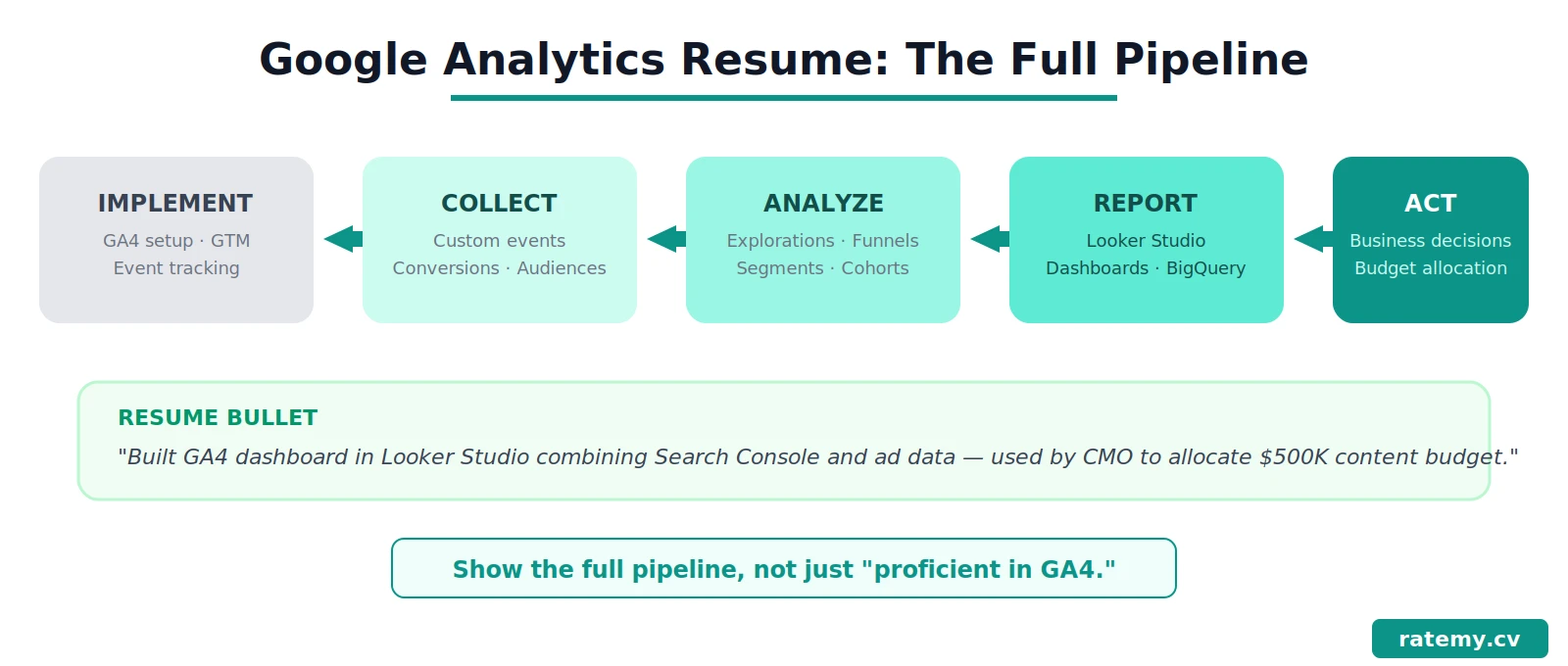
Listing GA4 without mentioning how data got into it (Google Tag Manager, data layer, custom events) or what you did with it downstream (Looker Studio, BigQuery, SQL analysis) makes your analytics skills look surface-level. Show the full pipeline: implementation → collection → analysis → insight → action.
Overweighting the Certification
The Google Analytics certification is valuable — but it is not a substitute for demonstrated experience. A resume that leads with the certification and has no analytics bullets in the experience section signals "I studied but haven't practiced." Pair the certification with real project work.
Making Your Resume Too Long
An analytics resume should be one page for early-career professionals and no more than two pages for experienced data analysts. Keep it focused on your strongest analytics work and most relevant skills.
How to Format a Google Analytics Resume (ATS-Friendly Tips)
Use a clean, single-column layout with standard section headers. Write "Google Analytics 4 (GA4)" in full at least once to catch ATS systems that search for the full product name. Also include "Google Analytics" and "GA4" separately, since job descriptions use both forms.
Save your resume as PDF or DOCX. Avoid graphics, skill bars, or chart-based skill visualizations — they look appealing but break ATS parsing. Use a professional font at 10-11pt.
Google Analytics Resume FAQs
How do I put Google Analytics certification on my resume? List it in a dedicated "Certifications" section: "Google Analytics Certification (GA4) — Google Skillshop, 2026." If you also hold the broader Google Data Analytics Professional Certificate, list that separately. Place certifications after your skills section or education for maximum visibility.
What skill is Google Analytics? Google Analytics is classified as a technical skill in the analytics and data category. It sits alongside tools like SQL, Tableau, Looker Studio, and Excel on a data analyst resume. For marketing roles, it is often listed under "Digital Marketing" or "Marketing Analytics" skills.
How do I list Google skills on my resume? Group them in your skills section: "Google Analytics 4, Google Tag Manager, Google Ads, Looker Studio, Google BigQuery, Google Sheets." List the specific Google tools you have used — do not just write "Google Suite" or "Google tools," as these are too vague for ATS matching.
What are the top 3 skills for a data analyst? SQL, data visualization (Tableau or Power BI), and analytics platforms (Google Analytics or Adobe Analytics). These three cover the core data analyst workflow: querying data, analyzing it, and presenting findings. Python is an increasingly common fourth requirement.
Is Google Analytics enough to get a data analyst job? On its own, no. Google Analytics demonstrates web analytics skills, but most data analyst roles also require SQL, data visualization tools, and the ability to work with structured and unstructured data beyond web traffic. Pair Google Analytics with SQL, Tableau or Power BI, and basic Python to build a competitive data analyst resume.
Check Your Analytics Resume Now
Not sure if your resume showcases Google Analytics effectively — or if the applicant tracking system can even parse your skills correctly? Upload your resume and a target job description to see exactly which analytics keywords you are missing.
Run your resume through RateMy.CV → — see exactly what ATS systems and hiring managers see, with specific feedback on missing keywords and weak bullets.
The scan takes 30 seconds and gives you a clear action plan for strengthening your analytics resume before your next application.
Related Resume Skills Guides
🎯 How does your resume score?
Upload your resume and a job description — our free scanner shows your match score, missing keywords, and what to fix. Takes 30 seconds.
Run Your Resume Through RateMy.CV — Free