
Power BI Skills Resume: What to List (2026)
Microsoft Power BI has become the default business intelligence tool for a huge number of organizations. Finance teams, marketing departments, operations groups, and executive leadership teams all rely on Power BI dashboards and reports to make decisions. That means the demand for professionals who can build, maintain, and optimize Power BI solutions is strong — and the resume competition for Power BI developer and Power BI data analyst roles is growing just as fast.
The problem is that most Power BI resumes look identical. They list "Power BI" in the skills section, maybe mention "created dashboards," and call it done. That tells a hiring manager nothing about your actual capability. Did you build a dashboard that 5 people use or 500? Did your reports replace a manual process or just visualize data nobody acted on? The difference between a Power BI resume that gets interviews and one that gets filtered out by the applicant tracking system is specificity.
This guide covers exactly which Power BI skills to put on your resume, how to structure your skills and experience sections for maximum ATS compatibility, how to write resume bullets that demonstrate real BI impact, and what separates a compelling Power BI resume from the hundreds of generic ones hiring managers see every week.
What Does a Power BI Developer Do?
Before diving into resume strategy, it helps to understand the scope of Power BI roles. A Power BI developer or Power BI data analyst typically builds interactive dashboards and reports, connects to multiple data sources, transforms raw data using Power Query, writes DAX formulas for calculated measures and KPIs, designs data models, manages data governance and security, and delivers business intelligence solutions that help organizations make data-driven decisions.
Some Power BI professionals work as dedicated BI developers. Others use Power BI as one tool among many in a broader data analyst or business intelligence analyst role. Your resume should reflect which type of role you are targeting — a specialist resume looks different from a generalist one.
Top Power BI Skills to List on Your Resume in 2026
Not every Power BI skill carries equal weight on a resume. Here are the ones that appear most consistently in job descriptions and generate the strongest response from recruiters.
Power BI Desktop and Service
This is the foundation. Every Power BI resume must demonstrate proficiency with both Power BI Desktop (where reports are built) and the Power BI Service (where they are published, shared, and managed). Specify which features you have used: report authoring, dashboard design, row-level security, workspace management, dataflows, paginated reports, and Power BI embedded.
Many candidates list "Power BI" and assume that covers everything. It does not. Detailing your experience with specific Power BI features signals depth that a generic mention cannot.
Resume example: Designed and published 25+ interactive Power BI dashboards across the Power BI Service, implementing row-level security for 8 department-level views and reducing executive report requests by 70% through self-service analytics.
DAX (Data Analysis Expressions)
DAX is the formula language that powers calculated columns, measures, and tables in Power BI. It is also one of the most reliable signals of Power BI expertise on a resume. Entry-level candidates may know basic SUM and COUNT functions, but mid-level and senior BI developers write complex DAX involving time intelligence functions, CALCULATE with filter context, iterator functions, and dynamic measures.
If you have written DAX beyond basic aggregations, say so explicitly. This is a skill that separates Power BI beginners from professionals.
Resume example: Wrote 40+ custom DAX measures including year-over-year growth calculations, rolling averages, and dynamic segmentation logic — enabling the sales team to analyze $18M in pipeline data across 6 regions without analyst support.
Data Modeling and Database Design
A Power BI dashboard is only as good as the data model behind it. Recruiters and technical screeners look for experience with star schema design, database normalization, relationship management, and performance optimization of data models. If you have designed data models that handle millions of rows efficiently, that belongs on your resume.
Understanding how tables relate to each other — facts, dimensions, bridge tables, many-to-many relationships — is what enables scalable, performant Power BI solutions. This is the skill that separates BI developers who build prototypes from those who build production-grade business intelligence solutions.
Resume example: Redesigned a legacy flat-table data model into a star schema with 4 fact tables and 12 dimensions, reducing Power BI report load time from 45 seconds to under 3 seconds for a dataset of 8M+ rows.
Power Query and ETL
Power Query is the data transformation engine within Power BI. Every BI professional needs to extract, transform, and load (ETL) data from multiple sources — SQL databases, Excel spreadsheets, APIs, SharePoint lists, cloud services — and Power Query is typically the first tool used for this.
On your resume, specify the types of data sources you have connected to and the complexity of your transformations. Merging tables, unpivoting columns, handling incremental refresh, parameterizing queries, and writing M code are all worth mentioning if you have done them.
Resume example: Built Power Query ETL pipelines connecting 14 data sources including SQL Server, SharePoint, and REST APIs — standardizing 3 departments' reporting data and eliminating 25 hours per month of manual Excel consolidation.
SQL and Database Skills
SQL is the most common companion skill to Power BI. Most Power BI data analysts write SQL queries to extract data from relational databases, build views, and optimize query performance before the data reaches Power BI. Microsoft SQL Server is the most common pairing, but experience with PostgreSQL, MySQL, Azure SQL, or data warehouses like Snowflake or Databricks also carries weight.
If you write SQL daily as part of your Power BI workflow, make sure both skills appear together on your resume. Listing Power BI without SQL can signal that you only work with pre-prepared data — which limits the roles you qualify for.
Resume example: Wrote optimized SQL queries against a 50M+ row SQL Server data warehouse, creating stored procedures and indexed views that reduced Power BI DirectQuery response time by 65%.
Reality check: Nobody gets hired for knowing DAX syntax alone. You get hired because your dashboards helped someone make a better decision faster. Every tool on your resume should point back to a business outcome.
Data Visualization and Dashboard Design
Building a Power BI dashboard is technical. Building a Power BI dashboard that people actually use is a design skill. Recruiters scan for evidence that your dashboards influenced decision-making — not just that they existed.
On your resume, describe what your dashboards tracked (KPIs, performance indicators, forecasting models), who used them (executives, department heads, field teams), and what decisions they supported. A dashboard adopted by the C-suite is more impressive than one viewed by three people.
Resume example: Created executive sales dashboard tracking 15 KPIs including revenue forecasting, customer retention rates, and pipeline velocity — adopted by VP of Sales and 4 regional directors for weekly business reviews.
Reality check: The most impressive Power BI resumes do not list every chart type you can build. They show that your dashboards changed how people made decisions. That is the difference between a BI developer who builds reports and one who drives business intelligence.
Microsoft Azure and Cloud BI
As organizations move their data infrastructure to the cloud, Power BI professionals who understand the broader Microsoft Azure ecosystem carry additional value. Experience with Azure Data Factory, Azure Synapse Analytics, Azure SQL, Azure Analysis Services, and Azure DevOps for BI deployment pipelines signals that you can work in modern cloud-based BI environments.
For senior Power BI roles and BI architect positions, cloud experience is increasingly a requirement rather than a nice-to-have.
Resume example: Architected end-to-end BI solution using Azure Data Factory for ETL, Azure Synapse for data warehousing, and Power BI for visualization — serving 200+ users across 3 business units with 99.8% uptime.
How to Write Power BI Resume Bullets
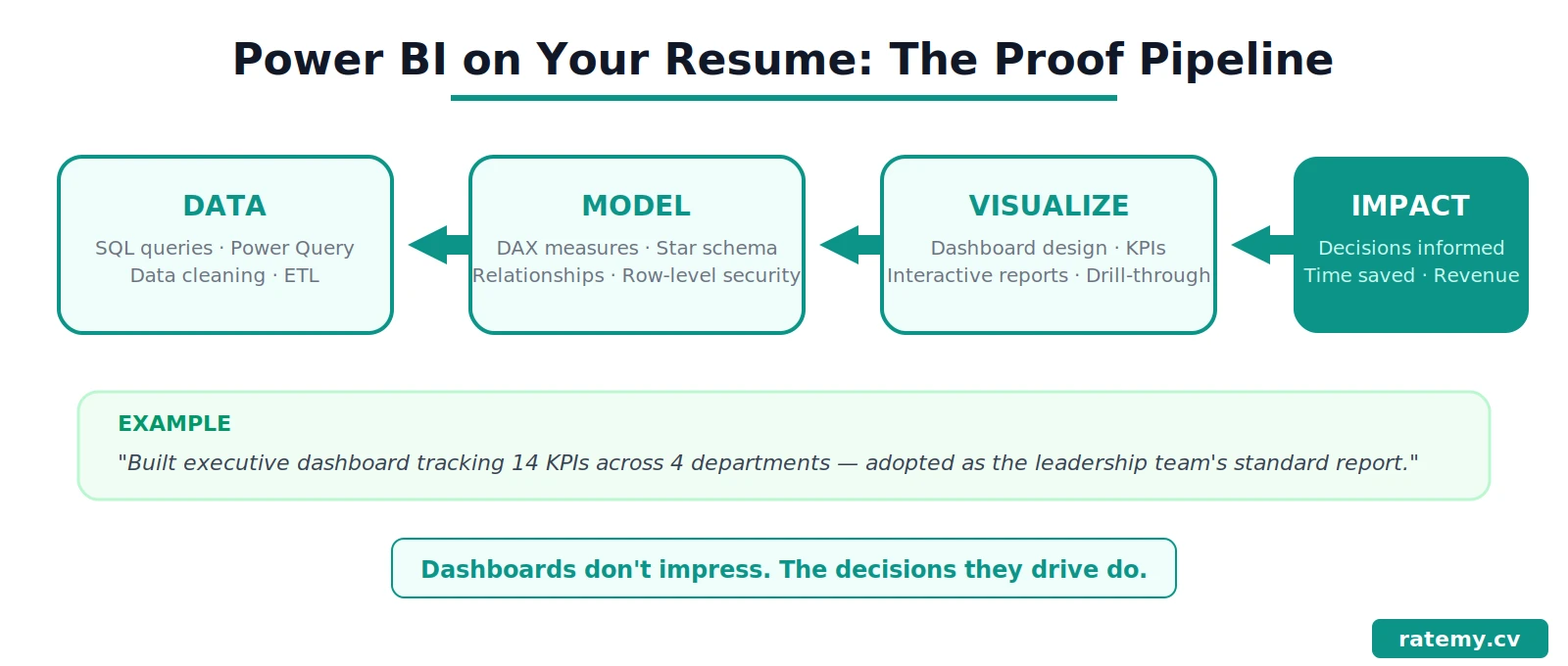
Use the Problem → Action → Result Framework
Every effective Power BI resume bullet answers three questions: what was the business problem, what did you build or do in Power BI, and what was the measurable result?
Weak: Created Power BI dashboards for the marketing team.
Strong: Built Power BI marketing attribution dashboard connecting Google Analytics, CRM, and ad platform data through Power Query, enabling the team to identify the 3 highest-ROI channels and reallocate $200K in annual ad spend.
The weak version tells hiring managers you know how to use Power BI. The strong version tells them you used Power BI to drive a business outcome worth talking about.
Quantify Your BI Impact
Power BI work produces measurable outcomes — you need to capture them on your resume. Metrics that work well include: number of dashboards built, users served, reports replaced, time saved, data sources connected, row counts handled, adoption rates, report load times, manual processes eliminated, and revenue or cost impact of decisions your dashboards informed.
Entry-level Power BI resume: Developed 8 Power BI reports during internship, consolidating data from 3 Excel files and 2 SQL databases into a unified sales dashboard used by a 15-person regional team.
Experienced Power BI developer: Managed a Power BI environment of 60+ reports and 15 workspaces serving 300 users, implementing automated refresh schedules and row-level security policies that reduced data access tickets by 85%.
Senior BI developer: Led migration from legacy SSRS reporting to Power BI across a 2,000-employee financial services organization, delivering 40+ interactive dashboards that replaced 120+ static reports and saved an estimated 500 analyst hours per quarter.
Tailor Your Resume for Each Power BI Role
A Power BI developer role emphasizes technical depth — DAX, data modeling, performance optimization, Azure integration. A Power BI data analyst role emphasizes business understanding — which KPIs matter, how to tell a story with data, how to make dashboards actionable. A BI consultant role emphasizes stakeholder management and the ability to translate business requirements into Power BI solutions.
Read each job description and reorder your skills and bullets accordingly. You can check your Power BI resume against any job description for free to see which keywords are missing.
Where to Put Power BI Skills on Your Resume
Skills Section
Group your Power BI and related skills into clear categories:
Business Intelligence: Power BI Desktop, Power BI Service, DAX, Power Query (M), Paginated Reports, Row-Level Security
Data & Analytics: SQL, Data Modeling (Star Schema), ETL, Data Warehousing, Data Governance, Data Quality
Databases: Microsoft SQL Server, Azure SQL, PostgreSQL, Snowflake, Databricks
Microsoft Stack: Azure Data Factory, Azure Synapse, SSRS, SSIS, Azure Analysis Services, Excel, SharePoint
Soft Skills: Stakeholder Communication, Requirements Gathering, Data Storytelling, Problem Solving
Power BI Resume Summary or Objective
Your resume summary should immediately communicate your Power BI expertise level, the types of solutions you build, and the business impact you deliver.
Entry-level Power BI resume summary: Microsoft Certified Power BI Data Analyst Associate with hands-on experience building interactive dashboards and writing DAX measures. Completed 5 Power BI projects using real-world data sets during coursework, including a customer segmentation dashboard that processed 100K+ records from 3 data sources.
Experienced Power BI resume summary: Power BI developer with 4+ years of experience designing enterprise BI solutions for finance and operations teams. Proficient in DAX, Power Query, SQL Server, and Azure Data Factory. Track record of building dashboards adopted by C-suite leadership and reducing manual reporting effort by 60%+ across multiple business units.
Education and Power BI Certifications
Power BI certifications validate your skills and are specifically searched for by applicant tracking systems. The most recognized certifications include Microsoft Certified: Power BI Data Analyst Associate (PL-300), Microsoft Certified: Azure Data Engineer Associate, and Microsoft Certified: Data Analyst Associate.
If you have completed the Microsoft Power BI learning path, Coursera or Udemy Power BI courses, or any formal BI training, include them in your education section — especially if you are a fresher or transitioning from a non-technical role.
Power BI Resume Examples by Experience Level
Power BI Resume for Entry-Level Candidates
If you are creating a Power BI resume with limited professional experience, focus on projects, certifications, and transferable skills. Build 2-3 portfolio projects using publicly available data sets — publish them to the Power BI Service and include links in your resume. A fresher who demonstrates working Power BI dashboards is more compelling than one who lists "Power BI: Intermediate."
What to emphasize: PL-300 certification, portfolio projects, SQL coursework, Excel proficiency, data visualization principles, any internship or freelance BI work.
Power BI Resume for 2 to 5 Years of Experience
At this level, your resume should demonstrate that you can work independently, handle complex data models, write advanced DAX, and deliver solutions that stakeholders rely on. Move beyond project descriptions and focus on business outcomes.
What to emphasize: Dashboard adoption metrics, data model optimization, Power Query automation, cross-functional collaboration, SSRS migration, performance tuning.
Senior Power BI Developer Resume
Senior BI developers and Power BI consultants need a resume that shows leadership, architecture decisions, and organizational impact. Your resume should demonstrate that you have shaped BI strategy — not just built individual reports.
What to emphasize: Enterprise BI architecture, Azure integration, data governance policy, team mentoring, vendor management, cost savings, BI center of excellence development.
Common Mistakes on a Power BI Resume
Listing "Power BI" Without Context
The single most common mistake. "Proficient in Power BI" or "Skills: Power BI, SQL, Excel" tells a hiring manager nothing. Every mention of Power BI should be accompanied by what you built, who used it, and what impact it had.
Ignoring DAX on Your Resume
Many Power BI professionals use DAX daily but forget to call it out on their resume. DAX is a specific, searchable keyword that applicant tracking systems look for. If you write DAX, list it explicitly in your skills section and reference it in your experience bullets.
Confusing Power BI with Excel
Some candidates describe basic Excel pivot charts and call it "Power BI experience." Technical screeners catch this immediately. Power BI and Microsoft Excel are complementary tools, but they are not interchangeable. Make sure your Power BI experience genuinely involves Power BI Desktop, DAX, Power Query, and the Power BI Service — not just Excel with a Power BI logo.
Not Mentioning Data Sources
A Power BI dashboard that connects to a single Excel file demonstrates different capability than one that integrates SQL Server, APIs, SharePoint, and Azure Data Lake. Always mention the data sources you connected and the complexity of your ETL process.
Making Your Resume Too Long
A Power BI resume should be one page for entry-level candidates and early-career professionals, and no more than two pages for experienced BI developers. Hiring managers review hundreds of resumes — a concise, well-structured resume outperforms a lengthy one every time.
How to Format a Power BI Resume (ATS-Friendly Tips)
Applicant tracking systems parse your resume before a human ever sees it. Formatting mistakes can cause your Power BI skills to be missed entirely.
Use a clean, single-column layout. Avoid tables, graphics, skill bars, and multi-column designs. Use standard section headers: "Skills," "Experience," "Education," "Certifications." Save your resume as PDF or DOCX. Write "Microsoft Power BI" in full at least once — some ATS systems search for the full product name. Also include "Power BI" as a standalone term since that is how most job descriptions reference it.
Use a standard professional font at 10-11pt. Avoid decorative elements that look good on screen but break ATS parsing.
Power BI Resume FAQs
How do you write Power BI skills on a resume? List Power BI in your skills section grouped under "Business Intelligence" or "Data & Analytics." Specify sub-skills: DAX, Power Query, data modeling, Power BI Service, row-level security. Then demonstrate each in your experience bullets with specific outcomes — dashboards built, users served, decisions influenced.
What kind of skill is Power BI? Power BI is classified as a technical skill and specifically a business intelligence and data visualization skill. On your resume, it sits alongside tools like Tableau, SQL, and Excel. It is one of the most in-demand BI tools on the market and appears in job descriptions across finance, marketing, operations, healthcare, and technology industries.
Can certifications replace experience on a Power BI resume? Not entirely, but they significantly strengthen a resume — especially for entry-level candidates and career changers. The Microsoft PL-300 (Power BI Data Analyst Associate) certification is the most recognized and is specifically searched for by applicant tracking systems. Pair it with 2-3 portfolio projects and you have a credible entry-level Power BI resume even without formal work experience.
Is Power BI a good skill to have in 2026? Yes. Microsoft Power BI continues to lead the business intelligence market in adoption. Organizations across every industry use it for reporting, analytics, and decision-making. Power BI skills are in demand for dedicated BI roles, data analyst roles, finance analyst roles, and increasingly for business analysts and operations professionals.
How should I present my Power BI projects on my resume? Treat projects like work experience. For each project, describe the business problem, the data sources you connected, the Power BI features you used (DAX, Power Query, data modeling), and the outcome. If the project is published to the Power BI Service or your portfolio, include a link.
Check Your Power BI Resume Now
Not sure if your resume lists Power BI skills effectively — or if the ATS can even find them? Upload your resume and a target job description to see exactly which keywords are missing and where your bullets need more impact.
Run your resume through RateMy.CV → — see exactly what ATS systems and hiring managers see, with specific feedback on missing BI keywords and weak bullets.
The scan takes 30 seconds and gives you a clear action plan for making your Power BI resume stronger before your next application.
Related Resume Skills Guides
🎯 How does your resume score?
Upload your resume and a job description — our free scanner shows your match score, missing keywords, and what to fix. Takes 30 seconds.
Run Your Resume Through RateMy.CV — Free