
SEO Skills Resume: Write One That Gets Interviews
SEO professionals have a unique resume problem. You spend your days optimizing content to rank in search engines — but most SEO resumes are not optimized at all. They list tools like Ahrefs and Semrush, mention "keyword research," and hope the hiring manager connects the dots. That is not enough.
The SEO job market in 2026 is flooded — agency applicants, in-house marketers, freelancers, even founders listing SEO as a side skill all compete for the same roles. Companies hire SEO specialists, SEO managers, SEO analysts, and technical SEO professionals across in-house teams, agencies, and freelance contracts. The candidates who land interviews are not the ones with the longest tool list — they are the ones who can prove they drove organic traffic growth, improved rankings, and generated revenue from search.
This guide covers exactly how to put SEO skills on your resume, which SEO strategies and tools to highlight, how to write resume bullets that demonstrate real results-driven SEO work, and what makes a standout SEO resume in 2026.
What Does an SEO Specialist Do?
An SEO specialist improves a website's visibility in organic search results by optimizing content, site architecture, technical performance, and backlink profiles. The day-to-day work varies by role — an SEO manager at a SaaS company focuses differently than an SEO analyst at a digital marketing agency — but the core responsibilities include keyword research, on-page optimization, technical SEO audits, content strategy, link building, performance reporting, and competitor analysis.
Understanding what type of SEO role you are targeting matters for your resume. An SEO specialist resume emphasizes hands-on execution. An SEO manager resume emphasizes strategy, team leadership, and cross-functional collaboration. An SEO analyst resume emphasizes data analysis, reporting, and search performance measurement.
Top SEO Skills to List on Your Resume in 2026
Keyword Research and Content Strategy
Keyword research is the foundation of every effective SEO strategy. It is also one of the first skills hiring managers look for on an SEO resume. But "keyword research" alone is too vague — specify the tools you use (Ahrefs, Semrush, Moz, Google Search Console, Google Keyword Planner) and the outcomes your research produced.
Strong SEO resumes connect keyword research to content strategy. Did your keyword research inform a content calendar? Did the pages you optimized rank for their target keywords? How much organic traffic did those pages generate?
Resume example: Conducted keyword research using Ahrefs and Semrush to identify 200+ content opportunities, building a content strategy that grew organic blog traffic from 15K to 85K monthly sessions in 12 months.
On-Page SEO and Content Optimization
On-page SEO covers everything that happens on the page itself: title tags, meta descriptions, header structure, internal linking, keyword placement, image optimization, schema markup, and content quality. This is the SEO skill most commonly listed on resumes — and therefore the one that requires the most specificity to stand out.
Do not just write "on-page SEO." Describe what you optimized, at what scale, and what the ranking results were. Marketing directors care about the traffic and revenue impact, not the number of meta descriptions you rewrote.
Resume example: Optimized 120+ product pages with targeted title tags, schema markup, and internal linking strategy — improving average position from 14.2 to 5.8 for core commercial keywords and increasing organic revenue by 38% year-over-year.
Technical SEO
Technical SEO skills are what separate an SEO specialist from a content marketer who knows basic keyword targeting. Technical SEO covers site speed optimization, crawl budget management, Core Web Vitals, mobile-first indexing, canonical tags, hreflang implementation, JavaScript rendering, XML sitemaps, robots.txt configuration, structured data, and site architecture.
If you have technical SEO experience, make it prominent on your resume. Technical SEO professionals command higher salaries and are harder to hire — which means this skill set carries significant weight with recruiters.
Resume example: Led technical SEO audit and remediation for a 50K-page e-commerce site, resolving 2,300+ crawl errors, implementing structured data across all product pages, and improving Core Web Vitals pass rate from 34% to 91% — resulting in a 22% increase in crawled pages per day.
Link Building and Off-Page SEO
Everyone says link building is dead — until their rankings stall. Link building remains one of the most difficult — SEO strategies. Hiring managers want to see that you can earn high-quality backlinks through digital PR, content marketing, guest posting, broken link building, or strategic partnerships. They also want to see that you understand link quality versus quantity.
On your resume, describe your link building strategies, the types of sites you earned links from, and the domain authority or traffic impact those links produced. Avoid vague language like "built backlinks" — specify the method and the result.
Resume example: Developed and executed link building campaigns using digital PR and data-driven content, earning 85+ referring domains from DA 50+ sites including industry publications — increasing domain rating from 32 to 51 over 8 months.
SEO Analytics and Reporting
Every SEO professional needs to measure and report on their work. Proficiency with Google Analytics (GA4), Google Search Console, and SEO platforms like Ahrefs, Semrush, or Moz is expected. What differentiates a strong SEO resume is showing that you did not just pull reports — you used data to inform strategy and communicate results to stakeholders.
Analytics managers and marketing directors scan for candidates who can translate SEO data into business language. If your reporting influenced budget decisions, content priorities, or strategic direction, describe that on your resume.
Resume example: Built monthly SEO performance dashboard in Looker Studio combining Google Search Console, GA4, and Ahrefs data — used by CMO and VP Marketing to allocate $500K annual content budget based on organic traffic ROI by topic cluster.
Local SEO
For agencies and businesses with physical locations, local SEO is a specialized and valuable skill. Experience with Google Business Profile optimization, local citation building, review management, local keyword targeting, and map pack ranking strategies belongs on your resume if the role involves local search.
Resume example: Managed local SEO for 35 franchise locations, optimizing Google Business Profiles and building consistent NAP citations — achieving map pack rankings for 28 locations and driving a 45% increase in "near me" search visibility.
Reality check: SEO tools change every year. The skill that never goes out of style is proving that your work produced measurable organic growth. Every SEO resume bullet should end with a number — rankings improved, traffic increased, revenue generated, or costs reduced.
SEO Tools and Platforms
List the specific SEO tools you have used. Applicant tracking systems scan for exact tool names, and hiring managers use your tool list to gauge your experience level. The most commonly requested SEO tools include:
Ahrefs, Semrush, Moz, Google Search Console, Google Analytics (GA4), Screaming Frog, Google Tag Manager, Looker Studio, Surfer SEO, Clearscope, Google Keyword Planner, and Google PageSpeed Insights.
For technical SEO roles, also list: Chrome DevTools, Schema.org markup, JavaScript rendering tools, and log file analysis tools. If you use Python for SEO automation — crawling, data analysis, or reporting — that is a strong differentiator worth highlighting.
How to Write SEO Resume Bullets That Stand Out
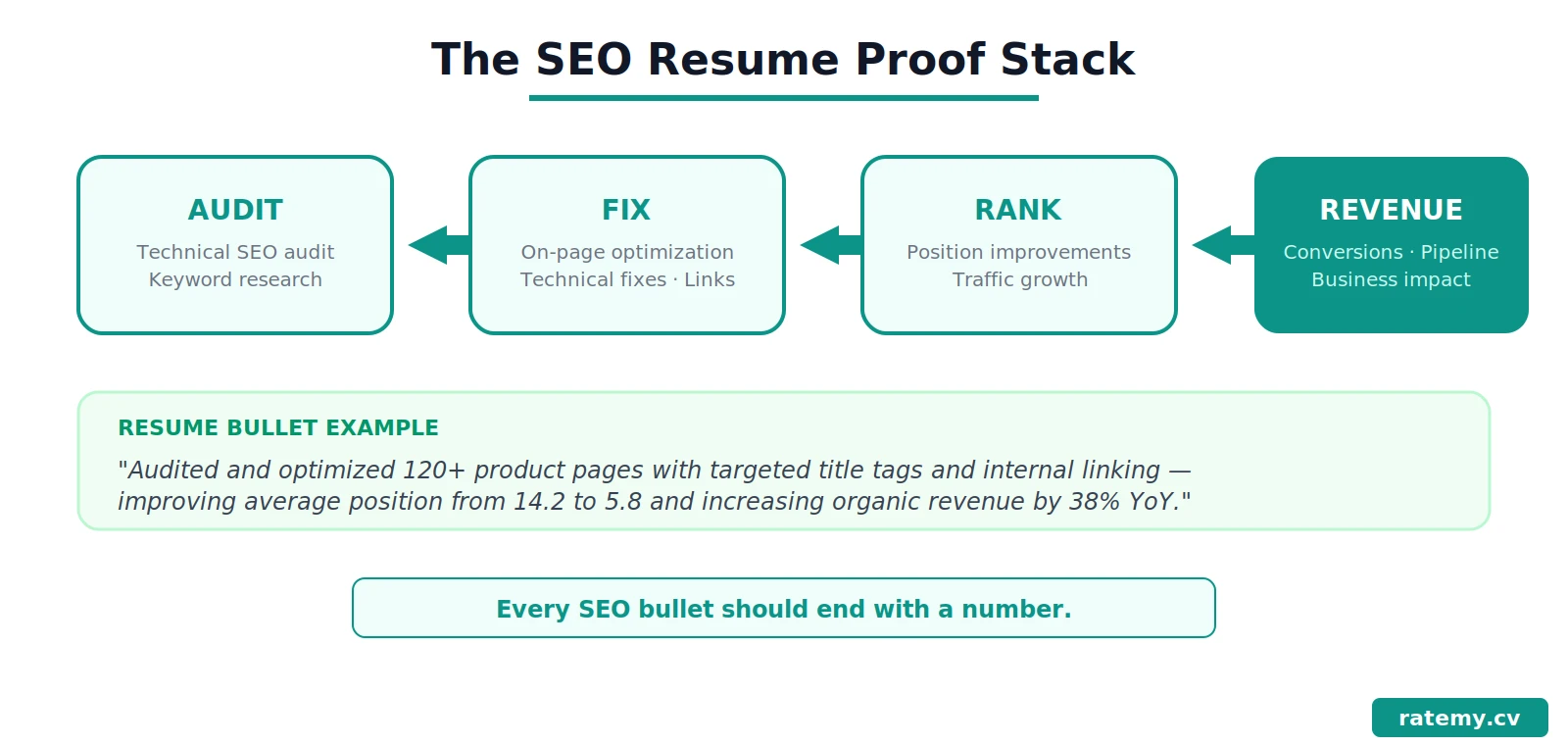
Use the Problem → Action → Result Framework
Every effective SEO resume bullet answers three questions: what was the organic search challenge, what SEO strategies did you implement, and what was the measurable result?
Weak: Responsible for SEO and content optimization across the company website.
Strong: Identified and resolved site-wide cannibalization across 80+ blog posts through content consolidation and redirect strategy, recovering 35% of lost organic traffic within 3 months and regaining page-one rankings for 12 priority keywords.
The weak version describes a job title. The strong version describes an SEO professional who diagnosed a problem, implemented a solution, and measured the outcome. That is what hiring managers remember.
Quantify Your SEO Success
SEO work is inherently measurable — your resume should reflect that. Metrics that work well on SEO resumes include: organic traffic growth (percentage and absolute numbers), keyword rankings improved, pages optimized, backlinks earned, domain authority/rating growth, conversion rate from organic traffic, revenue attributed to organic search, crawl efficiency improvements, and Core Web Vitals scores.
Entry-level SEO specialist: Wrote and optimized 40+ SEO-driven blog posts targeting long-tail keywords, achieving page-one rankings for 28 posts within 6 months and contributing 12K new monthly organic sessions.
Experienced SEO manager: Led SEO strategy for a B2B SaaS platform, growing organic traffic from 50K to 180K monthly sessions in 18 months through technical SEO improvements, content hub strategy, and strategic link building — organic became the #1 acquisition channel at 42% of total signups.
Senior SEO professional: Directed enterprise SEO program across 4 international markets and 12 language versions, implementing hreflang strategy, localized content optimization, and technical infrastructure improvements that increased global organic revenue by $3.2M annually.
Tailor Your Resume for Each SEO Job
An SEO specialist resume should lead with execution — keyword research, on-page optimization, link building results. An SEO manager resume should lead with strategy — team leadership, budget management, cross-functional collaboration, and program-level results. An SEO analyst resume should lead with data — reporting frameworks, traffic analysis, forecasting, and data-driven recommendations.
Read each job description and reorder your SEO skills and experience bullets to match. You can check your SEO resume against any job description for free to see exactly which keywords you are missing.
Where to Put SEO Skills on Your Resume
Skills Section
Group your SEO skills into clear categories for both ATS parsing and recruiter scanning:
SEO: On-Page SEO, Technical SEO, Link Building, Local SEO, Content Strategy, Keyword Research, Site Architecture, Schema Markup
SEO Tools: Ahrefs, Semrush, Moz, Screaming Frog, Google Search Console, Surfer SEO, Clearscope
Analytics: Google Analytics 4, Looker Studio, Google Tag Manager, Google Data Studio
Technical: HTML/CSS, JavaScript (basic), Python, Core Web Vitals, PageSpeed Optimization, XML Sitemaps, Robots.txt
Marketing: Content Marketing, Digital Marketing, Copywriting, Email Marketing, Conversion Rate Optimization
SEO Resume Summary or Objective
Your resume summary should immediately communicate your SEO specialization, experience level, and impact.
Entry-level SEO resume summary: Digital marketing professional with hands-on SEO experience across keyword research, on-page optimization, and content strategy. Grew organic traffic by 150% for 3 client websites during agency internship using Ahrefs, Google Search Console, and Semrush. Google Analytics certified.
Experienced SEO manager resume summary: SEO manager with 5+ years of experience driving organic growth for e-commerce and SaaS companies. Proficient in technical SEO, content strategy, and link building. Track record of growing organic traffic from 30K to 200K+ monthly sessions and managing $400K+ annual content budgets informed by SEO data.
SEO Resume Examples by Experience Level
Entry-Level SEO Resume
If you are writing your first SEO resume, focus on projects, internship results, freelance work, personal websites, and certifications. Even running SEO for a personal blog or a small business demonstrates real-world skills that many entry-level candidates lack.
What to emphasize: Google Analytics and Search Console proficiency, keyword research, content optimization, blog writing, basic technical SEO, certifications (Google Analytics, HubSpot, Semrush Academy).
Experienced SEO Specialist Resume
Mid-level SEO professionals should demonstrate strategic thinking and measurable results across multiple SEO campaigns. Your resume should show that you can manage projects end-to-end — from audit to strategy to implementation to reporting.
What to emphasize: Traffic growth results, ranking improvements, link building campaigns, technical SEO audits and fixes, cross-functional collaboration with content and development teams, tool expertise.
SEO Manager Resume
An SEO manager resume needs to demonstrate leadership, strategic planning, and business-level impact. At this level, hiring managers want to see that you have managed teams, budgets, and agency relationships — not just individual SEO tasks.
What to emphasize: Team management, SEO program ownership, budget allocation, executive reporting, cross-functional leadership, revenue attribution, international SEO, enterprise-scale optimization.
Common Mistakes on an SEO Resume
Listing Tools Without Results
The most common mistake on SEO resumes. "Proficient in Ahrefs, Semrush, and Moz" tells a hiring manager nothing about your capability. Every tool mention should connect to a result: what you found, what you did with it, and what changed.
Writing Vague SEO Bullets
"Implemented SEO strategies to improve organic visibility" could describe any SEO professional at any level. Effective SEO resume bullets include the specific strategy, the scale of implementation, and the measurable outcome.
Ignoring Technical SEO
Many SEO resumes focus entirely on content and keywords while ignoring technical SEO skills. If the job description mentions technical SEO, site speed, or Core Web Vitals and your resume does not address these, you are losing to candidates who cover both.
Not Tailoring to the SEO Role
An in-house SEO specialist role requires different emphasis than an agency SEO manager position. Submitting the same generic SEO resume to every application means you will match some job descriptions well and most of them poorly. Customize your skills section and bullet ordering for each application.
Making Your Resume Too Long
An SEO resume should be one page for entry-level professionals and no more than two pages for experienced SEO managers. Keep it focused on your strongest results and most relevant skills. Ironically, SEO professionals should know that concise, well-structured content outperforms bloated content — your resume is no different.
How to Format an SEO Resume (ATS-Friendly Tips)
Use a clean, single-column layout with standard section headers. Write "Search Engine Optimization (SEO)" in full at least once so the applicant tracking system catches both the spelled-out version and the acronym. Use standard fonts at 10-11pt. Save as PDF or DOCX.
Avoid graphics, skill bars, and percentage ratings. Avoid tables and multi-column layouts that break ATS parsing. Include both the full name and abbreviation for tools and concepts: "Google Analytics 4 (GA4)," "Core Web Vitals (CWV)."
SEO Resume FAQs
How do I put SEO skills on a resume? List SEO skills in a dedicated skills section grouped by category (On-Page, Technical, Tools, Analytics). Then demonstrate each skill in your experience bullets with specific outcomes — traffic grown, rankings improved, revenue generated. The skills section gets you past the ATS; the experience bullets convince the hiring manager.
What are basic SEO skills? The foundational SEO skills include keyword research, on-page optimization (title tags, meta descriptions, headers, internal linking), Google Search Console proficiency, Google Analytics, basic technical SEO (site speed, mobile-friendliness, crawlability), and content optimization. These are the minimum for any entry-level SEO position.
What are the 3 C's of SEO? Content, Code, and Credibility. Content refers to on-page optimization and content strategy. Code refers to technical SEO — site speed, structured data, crawlability. Credibility refers to off-page SEO — backlinks, domain authority, and trust signals. A strong SEO resume demonstrates experience across all three.
What if I don't have SEO experience? Start with certifications (Google Analytics, HubSpot SEO, Semrush Academy — all free), then apply your knowledge to a real project. Optimize a personal blog, volunteer for a nonprofit's website, or freelance for a small business. Document the results — even small traffic improvements demonstrate applied SEO skills on a resume.
What should I do if I have no experience in SEO? Build experience through personal projects and free certifications. Create a website, target specific keywords, track your results in Google Search Console, and document the process. Many SEO professionals started with a personal blog or side project that demonstrated their ability to rank content organically. That practical experience is more valuable on a resume than theoretical knowledge alone.
Check Your SEO Resume Now
Not sure if your resume showcases your SEO skills effectively — or if the ATS can even parse your optimization experience? Upload your resume and a target job description to see exactly which SEO keywords you are missing.
Run your resume through RateMy.CV → — see exactly what ATS systems and hiring managers see, with specific feedback on missing SEO keywords and weak bullets.
The scan takes 30 seconds. Because if you can optimize a website for search engines, you should be able to optimize your resume for hiring managers too.
Related Resume Skills Guides
🎯 How does your resume score?
Upload your resume and a job description — our free scanner shows your match score, missing keywords, and what to fix. Takes 30 seconds.
Run Your Resume Through RateMy.CV — Free