
Action Verbs for Resume: 200+ Words That Hit Harder
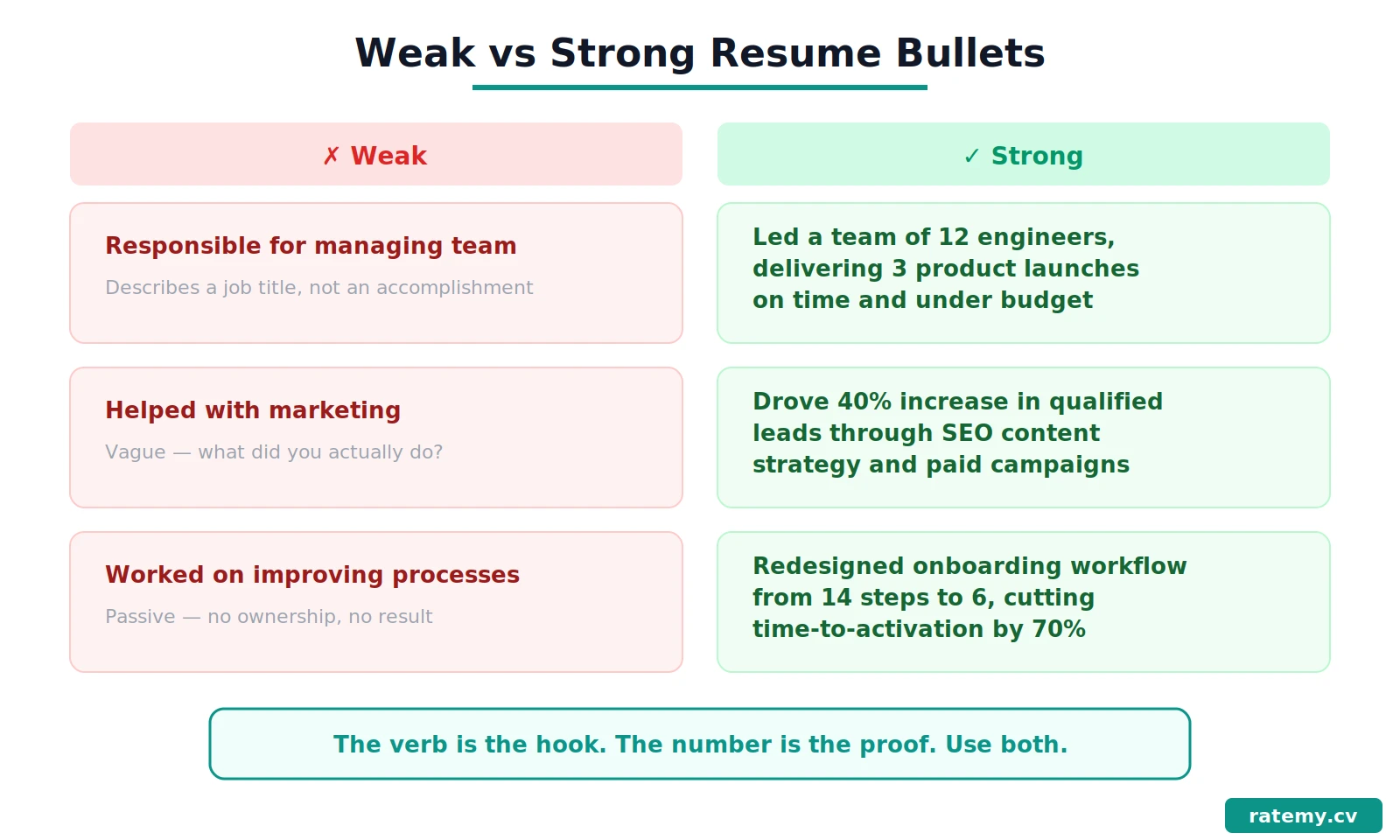
The difference between a resume that gets interviews and one that gets skimmed past often comes down to the first word of each bullet point. Most resumes start with the same tired phrases — "Responsible for," "Helped with," "Assisted in," "Worked on" — and every hiring manager has seen them a thousand times. Those weak openings signal that you are describing a job, not demonstrating impact.
Strong action verbs do the opposite. They tell a recruiter immediately what you did, how you did it, and what kind of professional you are — before they even reach the end of the sentence. "Redesigned the onboarding workflow" lands differently than "Was responsible for onboarding." "Negotiated a 15% vendor discount" hits harder than "Helped reduce costs." The verb carries the weight.
This guide gives you 200+ action verbs for your resume organized by the skill or accomplishment you want to highlight, with real examples showing how each verb transforms a generic bullet into one that makes a hiring manager stop and read.
Why Action Verbs Matter on Your Resume
Action verbs matter for two reasons that operate at different stages of the hiring process.
First, the ATS stage. Many applicant tracking systems parse your resume bullets for active language and keyword matches. Bullets that start with passive phrases like "Responsible for managing" often get parsed less cleanly than those starting with a direct verb like "Managed." The action verb is the keyword the system catches.
Second, the human stage. Recruiters and hiring managers spend about 7 seconds on an initial resume scan. In that time, they are reading the first few words of your top bullets. Strong action verbs create an impression of someone who acts, leads, builds, and delivers. Weak verbs create an impression of someone who was present but passive.
The pattern is simple: every resume bullet should start with a strong action verb in past tense (for previous roles) or present tense (for your current role). No exceptions. No "Responsible for." No "Duties included." No "Helped."
Action Verbs for Leadership and Management
If you managed a team, led a project, or directed an initiative, these verbs signal authority and ownership. Use them when your bullet describes a situation where you were in charge.
Led · Directed · Managed · Supervised · Oversaw · Coordinated · Spearheaded · Headed · Mentored · Guided · Chaired · Orchestrated · Mobilized · Championed · Steered · Delegated · Empowered · Cultivated · Coached · Inspired
Weak: Responsible for a team of 8 sales representatives.
Strong: Led a team of 8 sales representatives, implementing weekly pipeline reviews and coaching sessions that increased quarterly revenue by 23%.
More examples:
- Spearheaded a company-wide sustainability initiative across 4 departments, reducing energy costs by $120K annually.
- Mentored 5 junior analysts through a 6-month development program, with 4 earning promotions within the following year.
- Orchestrated a cross-functional product launch involving engineering, marketing, and sales — delivering on time despite a 3-week timeline compression.
Action Verbs for Accomplishments and Results
When your bullet describes something you achieved, improved, or delivered, these verbs emphasize the outcome — not just the activity.
Achieved · Delivered · Exceeded · Surpassed · Outperformed · Accomplished · Earned · Generated · Produced · Secured · Won · Captured · Attained · Completed · Realized
Weak: Met sales targets consistently.
Strong: Exceeded annual sales target by 18%, generating $1.4M in new revenue and earning President's Club recognition for the second consecutive year.
Action Verbs for Efficiency, Savings, and Process Improvement
These verbs show that you made things faster, cheaper, or better. They are especially powerful on resumes for operations, engineering, and management roles.
Streamlined · Optimized · Reduced · Eliminated · Consolidated · Simplified · Automated · Accelerated · Redesigned · Improved · Cut · Saved · Decreased · Minimized · Expedited · Restructured · Overhauled · Refined · Revamped · Transformed
Weak: Helped improve the reporting process.
Strong: Automated weekly reporting pipeline using Python, reducing manual data processing from 12 hours to 45 minutes and eliminating 3 recurring data entry errors.
More examples:
- Streamlined the customer onboarding process from 14 steps to 6, cutting average time-to-activation from 5 days to 1.5 days.
- Consolidated 4 separate CRM systems into a single Salesforce instance, saving $85K in annual licensing costs and improving data accuracy by 40%.
Action Verbs for Communication and Collaboration
If your work involved presenting, writing, training, or working across teams, these verbs highlight your interpersonal and communication skills.
Presented · Communicated · Collaborated · Partnered · Facilitated · Negotiated · Persuaded · Advocated · Briefed · Authored · Drafted · Composed · Conveyed · Translated · Mediated · Influenced · Liaised · Consulted · Advised · Trained
Weak: Worked with the marketing team on campaigns.
Strong: Collaborated with a 6-person marketing team to develop and execute 4 integrated campaigns, contributing customer insights that improved targeting accuracy and increased lead quality by 28%.
Action Verbs for Research and Analysis
For data-driven roles — analysts, researchers, scientists, strategists — these verbs show that you investigate, interpret, and draw conclusions from information.
Analyzed · Researched · Investigated · Assessed · Evaluated · Examined · Audited · Surveyed · Diagnosed · Mapped · Benchmarked · Forecasted · Measured · Quantified · Identified · Discovered · Validated · Tested · Modeled · Interpreted
Weak: Looked at customer data to find trends.
Strong: Analyzed 18 months of customer purchase data across 4 segments, identifying a cross-sell opportunity that generated $340K in incremental revenue within two quarters.
Action Verbs for Creative and Design Work
Designers, writers, marketers, and creative professionals need verbs that convey originality and craft.
Designed · Created · Developed · Built · Crafted · Conceptualized · Produced · Illustrated · Visualized · Branded · Launched · Published · Curated · Shaped · Composed · Engineered · Prototyped · Innovated · Originated · Reimagined
Weak: Made graphics for social media.
Strong: Designed a visual identity system and 150+ social media assets for a product rebrand, contributing to a 45% increase in Instagram engagement and 12K new followers in 3 months.
Action Verbs for Customer Service and Support
Customer-facing roles need verbs that show responsiveness, problem resolution, and relationship building.
Resolved · Supported · Assisted · Addressed · Responded · Served · Handled · Troubleshot · De-escalated · Retained · Onboarded · Educated · Advocated · Followed up · Satisfied
Weak: Answered customer calls and emails.
Strong: Resolved an average of 55 customer inquiries per day via phone and email, maintaining a 96% customer satisfaction rating and achieving first-contact resolution on 82% of cases.
Action Verbs for Financial and Revenue Impact
When your work directly affected the bottom line — sales, revenue, cost savings, budget management — use verbs that emphasize financial impact.
Generated · Increased · Grew · Maximized · Negotiated · Secured · Recovered · Budgeted · Forecasted · Allocated · Invested · Monetized · Capitalized · Fundraised · Reduced · Saved
Weak: Helped with the annual budget.
Strong: Managed a $2.4M departmental budget, negotiating vendor contracts that reduced operating costs by 18% while maintaining service quality across all 3 business lines.
Action Verbs for Technical and Engineering Roles
Engineers, developers, and technical professionals need verbs that convey building, solving, and shipping.
Engineered · Developed · Built · Architected · Deployed · Implemented · Configured · Integrated · Debugged · Migrated · Coded · Programmed · Automated · Tested · Shipped · Scaled · Provisioned · Refactored · Maintained · Optimized
Weak: Worked on the company website.
Strong: Architected and deployed a microservices-based API handling 10K+ requests per second, reducing average response latency from 800ms to 120ms and supporting a 3x increase in concurrent users.
Reality check: The verb is the hook, but the number is the proof. A strong action verb without a measurable result is still better than a weak verb — but the combination of a powerful verb plus a specific metric is what makes a resume bullet truly memorable. Every bullet on your resume should aim for both.
How to Use Action Verbs on Your Resume
Start Every Bullet with a Verb
No exceptions. Not "Responsible for managing," not "Duties included," not "Assisted with the implementation of." Just the verb. "Managed." "Implemented." "Designed." This forces you to write in active voice, which is shorter, clearer, and more impactful.
Match the Verb to the Job Description
Different roles value different types of action. A sales resume should be heavy on verbs like "generated," "negotiated," "closed," and "exceeded." An engineering resume should lean on "built," "deployed," "optimized," and "scaled." An operations resume should feature "streamlined," "reduced," "automated," and "coordinated."
Read the job description before submitting your resume and align your verb choices to the language the employer uses. If they say "drive growth," use "drove." If they say "collaborate cross-functionally," use "collaborated." This verb alignment is subtle but powerful for both ATS matching and recruiter impressions. Not sure which verbs your resume is missing? You can check your resume against any job description for free.
If you are also working on your resume summary, use 2-3 of your strongest action verbs there to set the tone. And if you need help deciding which computer skills or technical skills to pair with those verbs, those guides break it down by industry.
Avoid Repeating the Same Verb
Using "managed" in 6 out of 8 bullets makes your experience sound one-dimensional. Vary your verbs across bullets to show range. If you managed a team, managed a budget, and managed a project, rewrite as: "Led a team," "Oversaw a $1.2M budget," "Delivered a 6-month project."
Use Past Tense for Previous Roles, Present for Current
Previous positions: "Designed," "Led," "Built." Current position: "Design," "Lead," "Build." This is a small formatting detail that many resumes get wrong, and it distracts hiring managers who notice it.
Weak Action Verbs to Avoid on Your Resume
Some verbs actively hurt your resume because they signal passivity, vagueness, or lack of ownership:
"Responsible for" — This is not a verb. It describes a job description, not an accomplishment. Replace with the actual verb: what did you do?
"Helped" — Vague and diminishing. If you contributed meaningfully, use a verb that owns it: "co-developed," "supported," "contributed to."
"Worked on" — The most generic phrase possible. Replace with what you specifically did: "built," "designed," "analyzed," "coordinated."
"Assisted" — Similar to "helped." Use sparingly and only when you genuinely played a supporting role. Even then, specify what you did.
"Participated in" — Tells the hiring manager nothing about your contribution. Did you present? Facilitate? Analyze? Lead a workstream? Use that verb instead.
"Was involved in" — The weakest possible phrasing. Replace with any action verb that describes your actual contribution.
Action Verbs for Your Resume by Experience Level
Entry-Level and Student Resumes
If you are writing your first resume, you may feel like you have not "led" or "managed" anything. That is fine — strong verbs exist for every experience level:
Completed, Contributed, Assisted (sparingly), Organized, Researched, Developed, Created, Presented, Coordinated, Designed, Wrote, Planned, Built, Learned, Executed
Example: Researched and compiled a competitive analysis of 12 SaaS companies for a marketing strategy course, presenting findings to a panel of 3 industry professionals who selected it as the top project.
Mid-Level Resumes
At this stage, your verbs should show increasing ownership and impact:
Managed, Led, Drove, Launched, Implemented, Optimized, Scaled, Mentored, Negotiated, Delivered, Redesigned, Established, Pioneered
Senior and Executive Resumes
Senior professionals should use verbs that convey strategic impact and organizational influence:
Directed, Championed, Transformed, Spearheaded, Defined, Established, Architected, Governed, Envisioned, Influenced, Shaped, Steered
Action Verb Quick Reference by Resume Section
Resume Summary: Led, Drove, Delivered, Specialized, Built — use 2-3 strong verbs to establish your professional identity.
Work Experience: This is where the full range of action verbs lives. Every bullet, every role, starting with a strong verb.
Skills Section: You do not need verbs here — skills are nouns (Python, Project Management, Negotiation). Save your verbs for the bullets.
Education: Completed, Earned, Graduated, Studied, Specialized — brief and factual.
Action Verbs for Resume FAQs
What are the best action verbs for a resume? The best verbs are specific to your accomplishments: "Led" for leadership, "Analyzed" for research, "Built" for creation, "Reduced" for efficiency, "Generated" for revenue. Avoid generic verbs like "helped" or "worked on." The right verb depends on what you actually did — choose the one that most accurately captures your contribution.
Should I use action verbs in every resume bullet? Yes. Every bullet should start with a strong action verb in past tense (previous roles) or present tense (current role). If you only fix one thing on your resume, fix this. Every bullet should start with a strong action verb
Is it OK to use the same action verb more than once on my resume? Avoid it when possible. Repeating "managed" across multiple bullets makes your experience sound repetitive. Use synonyms to show range: "Led," "Oversaw," "Directed," "Coordinated," "Supervised" all convey management without repetition.
What are weak action verbs to avoid on a resume? Avoid "Responsible for," "Helped," "Worked on," "Assisted," "Participated in," and "Was involved in." These verbs are passive, vague, and fail to communicate your specific contribution. Replace each one with a verb that describes what you actually did.
What are the 5 P's of a resume? Profile (summary), Professional experience (work history), Projects (relevant work), Proficiencies (skills), and Proof (certifications, metrics, accomplishments). Strong action verbs strengthen the Professional experience and Projects sections most directly.
Check Your Resume Verbs Now
Not sure if your resume uses strong enough action verbs — or if it is full of "Responsible for" bullets that are costing you interviews? Upload your resume and see exactly where your bullets need stronger language.
Run your resume through RateMy.CV → — see exactly what ATS systems and hiring managers see, with specific feedback on weak bullets and missing impact language.
The scan takes 30 seconds. Because a strong verb is worth a hundred buzzwords.
🎯 How does your resume score?
Paste your resume and a job description — our free scanner shows your match score, missing keywords, and what to fix. Takes 30 seconds.
Scan My Resume — Free