
How to Write a Resume Summary That Gets Read
The resume summary is the most wasted space on most resumes. Two to three sentences at the top of the page — prime real estate that a hiring manager reads before anything else — and most people fill it with vague filler: "Results-driven professional with a proven track record of success seeking a challenging opportunity to leverage my skills in a dynamic environment." That sentence says absolutely nothing. It could describe anyone in any industry at any experience level. And recruiters recognize it instantly as a template that was never customized.
A strong resume summary does the opposite. In 2-3 sentences, it tells the hiring manager exactly who you are, what you do best, and what kind of impact you deliver — with enough specificity that they can immediately picture you in the role. It is your pitch. And like any pitch, it works only when it is specific to the audience.
This guide covers what a resume summary actually is, when you need one (and when you do not), how to write a resume summary that hiring managers actually read, and resume summary examples for every career stage and common situation.
What Is a Resume Summary?
A resume summary — also called a professional summary, career summary, or resume profile — is a short paragraph at the top of your resume that highlights your experience level, key skills, and most significant professional accomplishments. It sits directly below your name and contact information and above your work experience section.
A strong resume summary typically includes three elements: your professional identity (what you do and at what level), your core skills or expertise areas, and a headline accomplishment or two that proves your value. It is written in third person without pronouns — "Marketing manager with 6+ years" rather than "I am a marketing manager."
The summary has one job: give the hiring manager a reason to keep reading. Think of it as the answer to the question: "If you had 10 seconds to tell me three things about yourself, what would they be?"
Resume Summary vs. Resume Objective: Which One Should You Use?
A resume summary highlights what you bring to the table — your experience, skills, and results. A resume objective states what you want from the employer — "Seeking a position in marketing where I can grow my skills." The difference matters.
Resume objectives were standard 20 years ago. In 2026, they have largely been replaced by resume summaries because hiring managers care more about what you can do for them than what you want from them. The objective format survives only in one scenario: when you are making a career change and need to explain why you are applying for a role outside your previous field.
Use a resume summary if: You have 2+ years of relevant experience and want to highlight your strongest qualifications immediately.
Use a resume objective if: You are changing careers and need to connect your previous experience to a new field. Even then, frame it around value — what you bring, not what you seek.
Skip both if: You are entry-level with limited experience and your resume is already one page. The space may be better used for an additional project or experience bullet.
How to Write a Resume Summary That Works
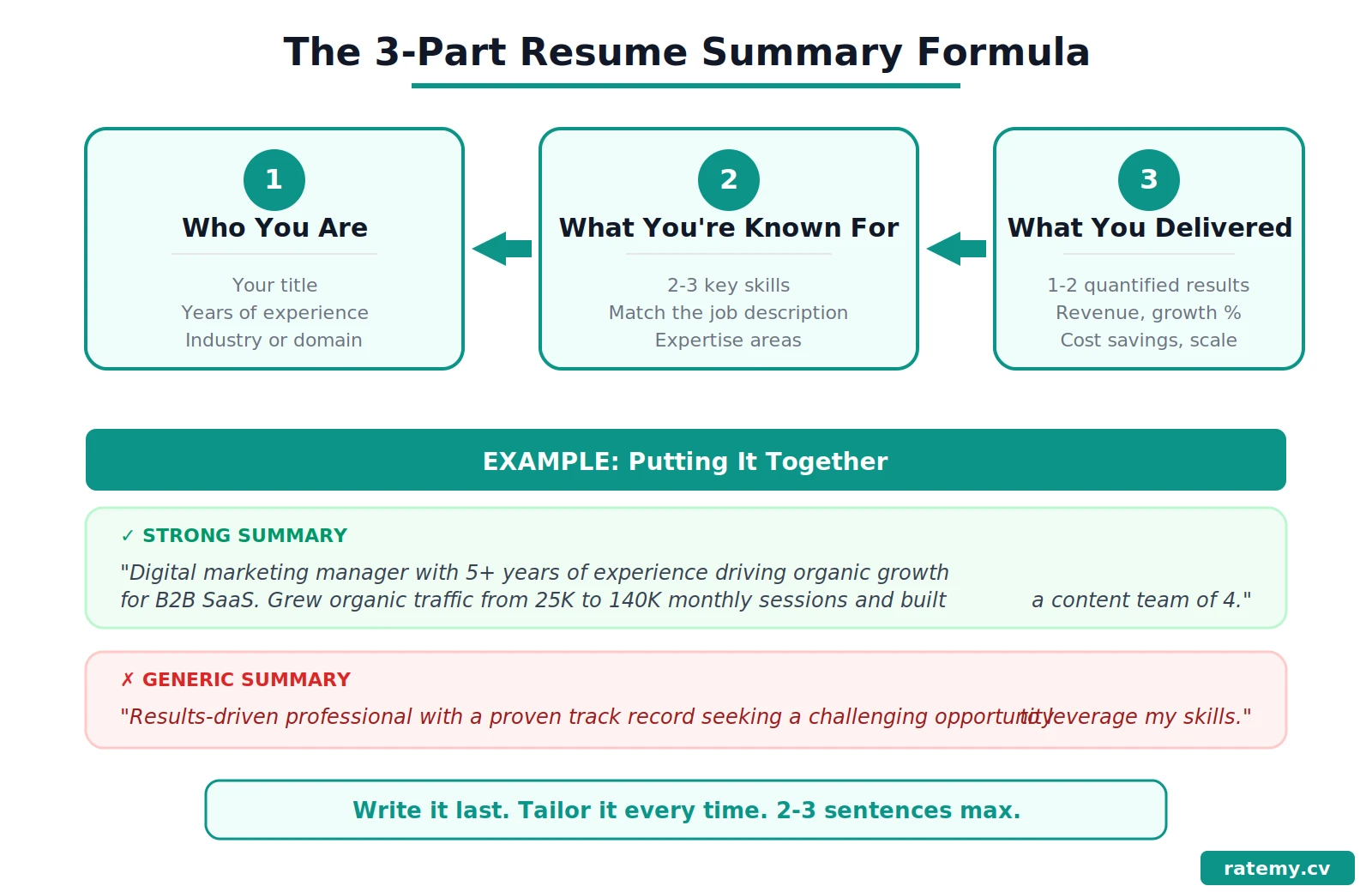
The 3-Part Formula
Every effective resume summary follows a simple structure:
Part 1 — Who you are: Your professional title, years of experience, and industry or domain.
Part 2 — What you are known for: Your 2-3 strongest skills or expertise areas, ideally matching the job description. If you need help identifying which skills to highlight, our guides on computer skills for resume and problem-solving skills break it down by role type.
Part 3 — What you have delivered: One or two quantified accomplishments that prove your value.
That is it. Three parts, 2-3 sentences, roughly 40-60 words. Anything longer and the hiring manager stops reading. Anything vaguer and they forget you immediately.
Formula in action:
[Title] with [X+ years] of experience in [industry/domain]. Skilled in [skill 1], [skill 2], and [skill 3]. [Quantified accomplishment that demonstrates impact].
Write It Last
This sounds counterintuitive, but write your resume summary after you have finished the rest of your resume. Your experience bullets contain your strongest accomplishments. Your skills section contains your most relevant keywords. The summary is a distillation of those — the highlight reel. Writing it first means guessing. Writing it last means selecting your best material.
Tailor It to Every Job
A resume summary that works for every application works for none of them. The summary should reflect the specific role you are applying for — mirroring the job description's language, emphasizing the skills they prioritize, and highlighting the accomplishment most relevant to their needs.
Five minutes of tailoring beats sending the same summary to 50 companies. Read the job description, identify the top 2-3 requirements, and rewrite your summary to lead with those. This single adjustment dramatically increases the chances that both the ATS and the hiring manager see you as a fit.
Include Keywords From the Job Description
Your resume summary is one of the first sections the applicant tracking system parses. Including keywords from the job description — specific skills, tools, certifications, industry terms — increases the likelihood of passing the ATS filter. But weave them naturally into sentences rather than stuffing them in awkwardly.
Keyword-stuffed: Results-driven marketing professional with skills in SEO, SEM, PPC, CRO, email marketing, social media marketing, content marketing, and digital strategy.
Natural: Marketing manager with 5+ years of experience driving organic growth through SEO and content strategy. Built and scaled a content program that grew organic traffic from 20K to 150K monthly sessions and generated 40% of the sales pipeline.
The verbs in your summary matter too — "Built," "Drove," and "Scaled" are far stronger than "Responsible for" or "Helped with." See our action verbs guide for more on choosing the right words.
Reality check: The resume summary is not a personality statement. "Passionate, driven, detail-oriented team player" is noise. Hiring managers skip it. What they read is: role, years, skills, and one number that proves you deliver. Give them that and nothing else.
Resume Summary Examples by Career Stage
Entry-Level Resume Summary (0-2 Years)
Entry-level summaries are tricky because you have limited experience to draw from. Focus on education, relevant skills, internships, projects, and any early results you can quantify.
Example — Recent graduate: Business administration graduate with internship experience in financial analysis and client reporting. Proficient in Excel (pivot tables, VLOOKUP), SQL, and Tableau. Built a customer segmentation model during internship that identified 3 high-value segments and informed a $50K marketing reallocation.
Example — Career starter: Customer service professional with 1 year of experience in high-volume retail environments, handling 80+ customer interactions daily with a 97% satisfaction rating. Skilled in POS systems, CRM data entry, and conflict resolution.
Mid-Career Resume Summary (3-7 Years)
At this stage, your summary should demonstrate ownership, growing responsibility, and measurable impact. Lead with your specialty and your strongest result.
Example — Marketing: Digital marketing manager with 5 years of experience leading SEO, content, and paid acquisition strategies for B2B SaaS companies. Grew organic traffic from 25K to 140K monthly sessions, managed a $300K annual ad budget, and built a content team of 4 that produced 60+ ranking articles.
Example — Operations: Operations coordinator with 4 years of experience streamlining supply chain and fulfillment processes for e-commerce companies. Reduced order processing time by 40%, implemented inventory management system that cut stockout incidents by 60%, and managed vendor relationships across 12 suppliers.
Example — Engineering: Full-stack software engineer with 5+ years of experience building and scaling web applications using React, Node.js, and PostgreSQL. Led development of a customer portal serving 50K monthly active users with 99.9% uptime. Reduced deployment time from 2 hours to 8 minutes through CI/CD automation.
Senior and Executive Resume Summary (8+ Years)
Senior summaries should emphasize leadership, strategic impact, and organizational-level results. At this career stage, hiring managers assume technical competence — they want to see scope, scale, and influence.
Example — Senior manager: Senior product manager with 10+ years of experience leading cross-functional teams through 0-to-1 product launches and growth-stage optimization for SaaS and fintech platforms. Managed a $4M product portfolio, grew flagship product ARR from $1.2M to $5.8M, and led a team of 8 across product, design, and engineering.
Example — Director: VP of Sales with 12 years of experience building and scaling B2B sales organizations from early stage to $50M+ ARR. Built 3 sales teams from scratch, implemented Salesforce-driven pipeline management, and consistently delivered 110-120% of annual quota across enterprise and mid-market segments.
Career Change Resume Summary
When you are switching industries or functions, the summary needs to bridge your previous experience with the new role. Lead with transferable skills and the reason you are a credible candidate — not with "seeking an opportunity."
Example — Teacher to corporate trainer: Former high school educator with 6 years of experience designing curriculum and delivering instruction to groups of 30+, transitioning to corporate learning and development. Created a data literacy workshop adopted by 3 school districts. Skilled in instructional design, public speaking, and LMS platforms (Canvas, Moodle).
Example — Military to project management: U.S. Army logistics officer transitioning to civilian project management, with 8 years of experience coordinating complex operations across 50+ personnel and $10M+ in equipment. PMP certified. Led supply chain operations across 3 deployment cycles with zero critical inventory failures.
Resume Summary With No Experience
If you have no formal work experience, you can still write a summary — but it should focus on education, skills, and projects rather than job titles.
Example — Student: Computer science student at Penn State with hands-on experience in Python, SQL, and data visualization through 4 academic projects. Built a web scraping tool that collected and analyzed 10K+ product listings for a market research course, presenting findings to a panel of industry professionals.
What Makes Resume Summaries Fail
Being Too Generic
"Results-driven professional with a proven track record" is the single most common resume summary failure. It sounds impressive but communicates zero information. If your summary could belong on anyone's resume, it is too generic. Add your specific role, industry, and a number.
Writing a Paragraph Instead of a Summary
A resume summary should be 2-3 sentences. Not 5. Not a full paragraph. Hiring managers spend seconds on initial screening — a 6-line summary block gets skipped entirely. Be concise. Every word should earn its place.
Listing Soft Skills Without Evidence
"Strong communicator with excellent leadership skills and attention to detail" is a list of adjectives, not a summary. If you mention communication or leadership, attach it to an accomplishment: "Led a cross-functional team of 12 through a product migration" demonstrates leadership far more effectively than claiming it.
Forgetting to Tailor
Submitting the same summary to every application means it will be perfectly relevant to approximately zero of them. The summary should change for each job — not a full rewrite, but shifting which skills and accomplishments you lead with based on what the job description prioritizes.
Including Resume Objectives Language
"Seeking a challenging position where I can leverage my skills" is objective language, not summary language. The summary is about what you offer, not what you want. Replace "seeking" with "delivering," "building," or "driving."
Where Does the Resume Summary Go?
The resume summary sits at the top of your resume, immediately below your name, contact information, and LinkedIn profile link. It should be the first thing a hiring manager reads after your name. Do not bury it below your skills section or education — it goes at the top because it frames everything that follows.
Format it as a short paragraph — not bullet points. The summary is prose. Your experience bullets are where lists belong.
How Long Should a Resume Summary Be?
Two to three sentences. Roughly 40-60 words. That is enough to communicate who you are, what you do, and what you have accomplished — without overstaying your welcome. If your summary is longer than 3 sentences, cut it. If it is shorter than 2, it is probably too vague to be useful.
Resume Summary FAQs
What is a good summary for a resume? A good resume summary states your professional title, years of experience, 2-3 key skills relevant to the job, and one quantified accomplishment — in 2-3 sentences. It should be specific enough that a hiring manager can immediately understand what you do and what kind of results you deliver.
How do I write a summary about myself for a resume? Use the 3-part formula: who you are (title + years + industry), what you are known for (top skills), and what you have delivered (one quantified result). Write it in third person without "I." Write it last, after completing the rest of your resume, so you are selecting from your best material.
Should I write a summary or an objective? Use a summary in almost all cases — it highlights your value. Use an objective only if you are changing careers and need to explain why you are pivoting. Even then, frame the objective around what you bring to the new role, not what you want from it.
Can I use the same summary for every job application? You can use the same base structure, but you should tailor it for each application by adjusting which skills and accomplishments you lead with. Mirror the job description's language and priorities. This 5-minute adjustment significantly increases your interview rate.
How do I write a resume summary with no experience? Focus on education, skills, projects, and any relevant extracurricular work. Use the same 3-part formula but replace "years of experience" with your degree or relevant training, and replace professional accomplishments with project outcomes or academic results.
Check Your Resume Summary Now
Not sure if your resume summary is working for you — or against you? Upload your resume and a target job description to see exactly how your summary reads to ATS systems and hiring managers.
Run your resume through RateMy.CV → — see exactly what automated screeners and hiring managers see, with specific feedback on your summary, missing keywords, and weak bullets.
The scan takes 30 seconds. Because a strong summary does not just describe you — it makes someone want to meet you.
🎯 How does your resume score?
Paste your resume and a job description — our free scanner shows your match score, missing keywords, and what to fix. Takes 30 seconds.
Scan My Resume — Free